Globe’s network infrastructure stable, 100% operational following Hinatuan quake
Globe’s network infrastructure and facilities in quake-hit areas in Mindanao did not sustain any damage due to the powerful temblor, with connectivity services stable across the region. The 7.4-magnitude quake, which triggered a tsunami warning, was also felt in parts of Eastern Visayas and Mindanao, including Samar, Leyte, Negros, Cebu, the Davao Region, Agusan del

By Staff Writer
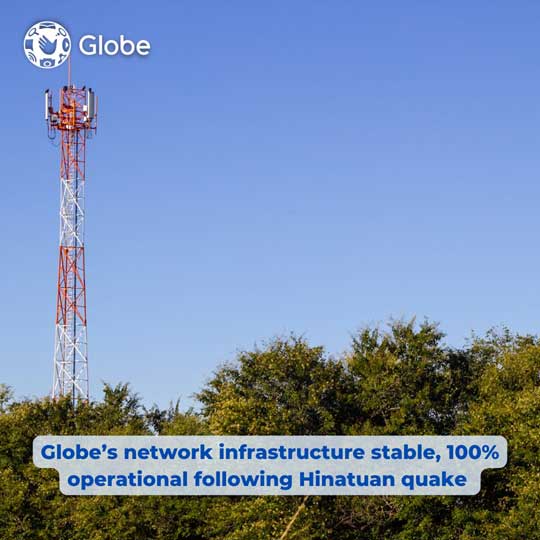
Globe’s network infrastructure and facilities in quake-hit areas in Mindanao did not sustain any damage due to the powerful temblor, with connectivity services stable across the region.
The 7.4-magnitude quake, which triggered a tsunami warning, was also felt in parts of Eastern Visayas and Mindanao, including Samar, Leyte, Negros, Cebu, the Davao Region, Agusan del Norte, Agusan del Sur, Bukidnon, Saranggani, Maguindanao, and the Zamboanga Peninsula, according to Phivolcs.
Connectivity remains stable in affected areas, with contingency measures long in place, including generator sets and batteries, to ensure uninterrupted service.
“All Globe facilities in quake hit areas in Mindanao are 100% operational, and we did not encounter any major service interruption in the immediate aftermath. We know that connectivity is crucial especially during disasters that is why we continue to focus on our network resilience,” said Yoly Crisanto, Chief Sustainability and Corporate Communications Officer, Globe Group.
“Our teams on the ground together with partner organizations are assisting affected communities with our suite of digital solutions and other interventions,” Crisanto added.
For more information about Globe’s disaster response efforts, please visit globe.com.ph
Article Information
Comments (0)
LEAVE A REPLY
No comments yet
Be the first to share your thoughts!