
Three snake species released back into habitat
By Jennifer P. Rendon
By Jennifer P. Rendon
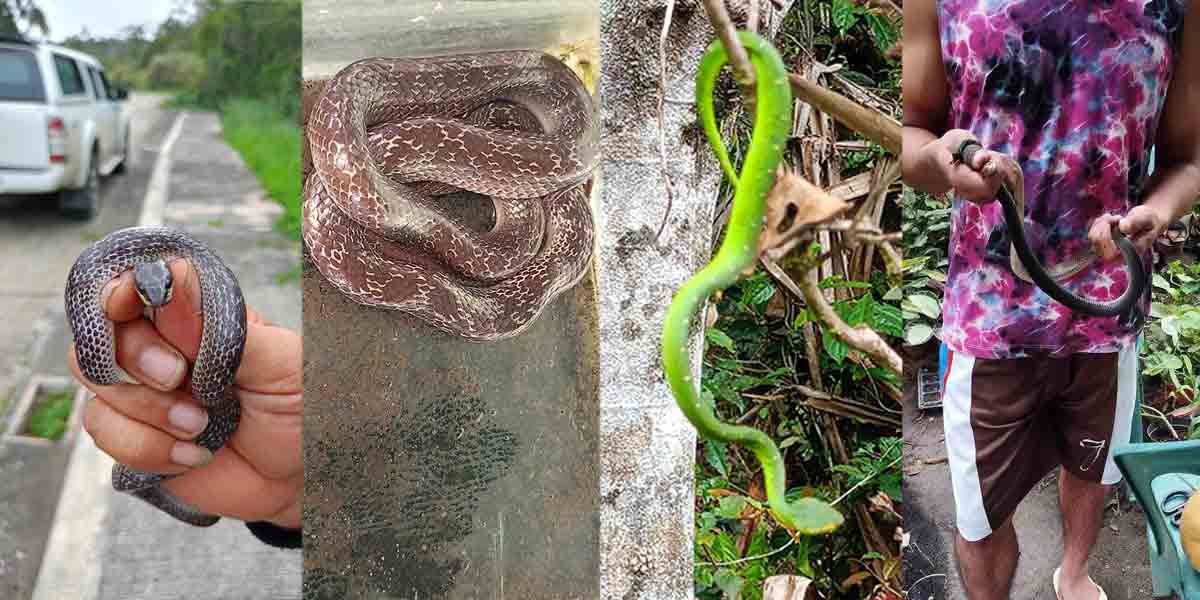
The Department of Environment and Natural Resources (DENR) – Region 6, through the Community Environment and Natural Resources Office (CENRO) of Belison, Antique, released three different snake species back to their natural habitat on July 1.
DENR-6 stated that a rat snake, a Philippine pit viper, and a wolf snake were returned to the forest area of San Remigio, Antique.
A Philippine rat snake (Coelognathus erythrurus), locally known as “maninina,” is nonvenomous and typically preys on rats and other small animals. It was turned over by Mr. and Mrs. De Guia, residents of Barangay Maybato North, San Jose, Antique.
The North Philippine temple pit viper (Tropidolaemus subannulatus), or “dupong,” and the wolf snake (Lycodon capucinus), or “paparay,” were turned over by Ken and Andrie Ordanel, residents of Villavert Compound, Barangay 5, San Jose town.
The pit viper is a highly venomous lowland ambush predator known for its bright green color, which helps it camouflage in its natural environment. The wolf snake is named for its enlarged front teeth. Although nonvenomous, a bite from it can cause pain and swelling.
“These snakes, as well as other wild fauna, belong in the wild. They maintain the balance of our ecosystem. Protecting them and keeping them away from the public, who can harm them, is one way to give back,” said DENR-6 Regional Executive Director Raul L. Lorilla.
The agency also urged the public to report any found or rescued wild animals and turn them over to the proper authorities for appropriate handling. (With reports from DENR-6)
Comments (0)
LEAVE A REPLY
No comments yet
Be the first to share your thoughts!


