Guimaras March inflation rises to 1.6%
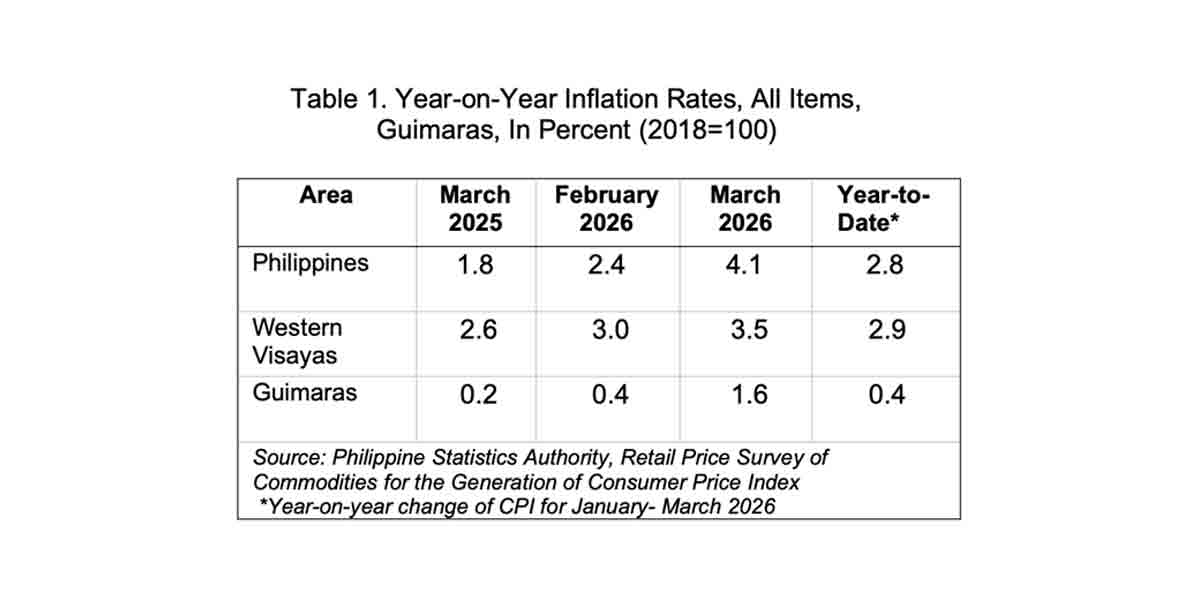
Inflation in Guimaras accelerated to 1.6% in March 2026 from 0.4% in February, bringing the province’s average inflation for the first quarter to 0.4%, according to the Philippine Statistics Authority. The March inflation rate was also higher than the 0.2% recorded in March 2025, reflecting faster price increases for goods and services in the province.
By Staff Writer

Inflation in Guimaras accelerated to 1.6% in March 2026 from 0.4% in February, bringing the province’s average inflation for the first quarter to 0.4%, according to the Philippine Statistics Authority.
The March inflation rate was also higher than the 0.2% recorded in March 2025, reflecting faster price increases for goods and services in the province.
“The latest movement indicates growing price pressures toward the end of the first quarter of the year,” Provincial Statistics Officer Nelida B. Losare said.
The increase was driven mainly by higher transport costs, which surged to 18.2% in March from 6.0% in February.
“This was followed by higher inflation in housing, water, electricity, gas and other fuels at 2.4 percent from 1.2 percent,” Losare said.

“Also, food and non-alcoholic beverages showed an uptick at -2.1 percent from -3.2 percent, contributing to the overall increase in inflation,” Losare added.
Losare said transport accounted for the largest share of the inflation uptrend in March at 48.4%, driven mainly by higher prices for the operation of personal transport equipment, particularly fuels and lubricants.
“Notably, diesel and gasoline registered significant increases during the month,” Losare said.
“Passenger transport services also exhibited price increases, especially in passenger transport by sea and inland waterways, which further contributed to the rising inflation trend,” she added.
Food and non-alcoholic beverages accounted for 31.6% of the overall uptrend in March inflation, driven mainly by price movements in cereals and cereal products, including rice.
“Increases were also observed in fish and other seafood as well as fruits and nuts, contributing further to the overall inflation trend during the month,” Losare said.
Housing, water, electricity, gas and other fuels contributed 10.9% to the overall uptrend in March inflation.
Losare said the increase in that commodity group was largely driven by higher prices for electricity, gas and other fuels, particularly electricity.
“In addition, liquefied hydrocarbons and liquid fuels, including kerosene, contributed to the upward movement, further supporting the rise in inflation in this commodity group,” Losare said.
Other commodity groups that posted faster annual increases in March included personal care and miscellaneous goods and services at 2.9%, clothing and footwear at 3.6%, health at 7.5%, and furnishings, household equipment and routine household maintenance at 1.4%.
By contrast, alcoholic beverages and tobacco, recreation, sport and culture, and restaurants and accommodation services recorded slower inflation rates in March at 3.2% from 6.1%, -2.0% from -1.9%, and 6.3% from 14.3%, respectively.
Information and communication, education services, and financial services retained their February inflation rates at 1.8%, 0.8%, and 0.0%, respectively.
In terms of contribution to the March inflation rate, transport posted the largest share at 83.6%, or 1.34 percentage points.
“This was followed by restaurants and accommodation services, which contributed 21.9 percent or 0.35 percentage point, and housing, water, electricity, gas and other fuels, which contributed 20.2 percent or 0.32 percentage point,” Losare said.
Within the transport commodity group, passenger transport services contributed the largest share at 47.3%, or 0.76 percentage point.
“This was followed by the operation of personal transport equipment, contributing 34.6 percent or 0.55 percentage point, largely influenced by higher prices of fuels such as gasoline,” Losare said.
In restaurants and accommodation services, most of the contribution came from food and beverage serving services, particularly restaurants, cafes and similar establishments, which accounted for 21.4%, or 0.34 percentage point, of overall inflation.
Losare said inflation is derived from the Consumer Price Index, which measures changes over time in the average prices of goods and services commonly purchased by households.
In March 2026, the CPI in Guimaras stood at 131.6.
“The CPI serves as the primary indicator used in computing the inflation rate, as it tracks movements in the prices of a fixed basket of goods and services typically consumed by households,” Losare explained.
She said this means a typical Guimarasnon household would need PHP1,316 in March 2026 to buy the same basket of goods and services that cost PHP1,000 in 2018, the base year used for computing the CPI.
Meanwhile, the purchasing power of the peso in Guimaras slipped to PHP0.74 in March from PHP0.75 in each of the previous two months, indicating a slight weakening in the peso’s buying power during the first quarter.
“Overall, while inflation remained relatively manageable in the first quarter, the increase in March signals emerging price pressures that require close monitoring in the coming months,” Losare said.
Article Information
Comments (0)
LEAVE A REPLY
No comments yet
Be the first to share your thoughts!