
Forum on potential of jurisdictional sustainability for climate finance
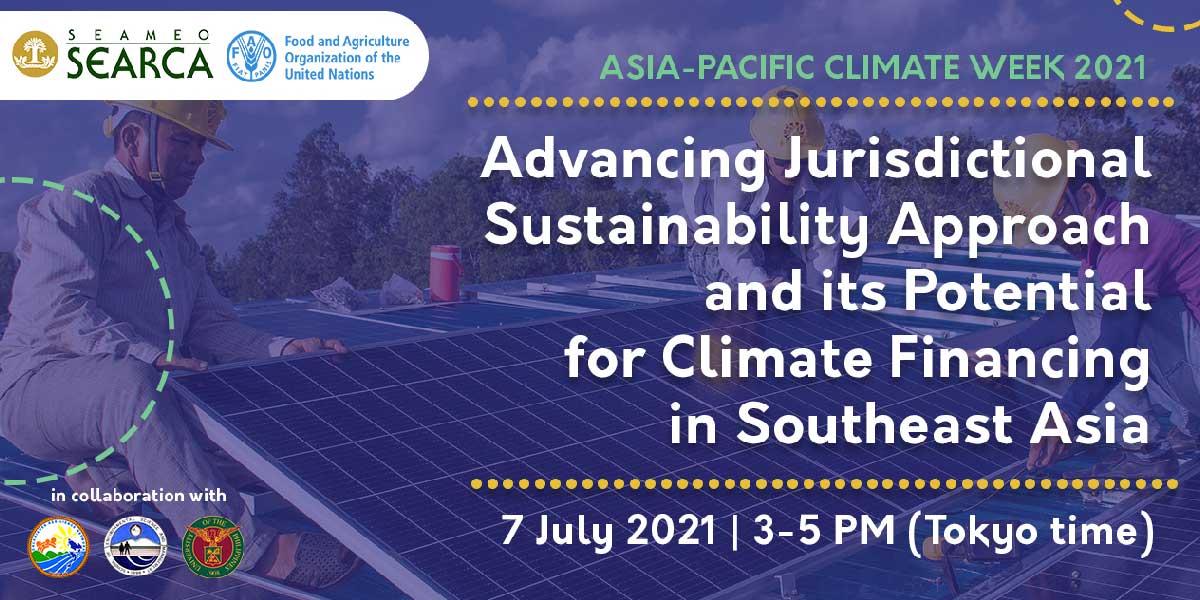
The Southeast Asian Regional Center for Graduate Study and Research in Agriculture (SEARCA) and the Food and Agriculture Organization of the United Nations (FAO) are jointly organizing a session on “Advancing Jurisdictional Sustainability Approach and its Potential for Climate Financing in Southeast Asia” on July 7 during the Asia-Pacific Climate Week (APCW) 2021. The forum will be convened in collaboration with the University of the Philippines Los Baños-School of Environmental Science and Management (UPLB-SESAM).
“Jurisdictional Sustainability is large-scale sustainable development that is climate-friendly,
equitable, and provides social inclusion across large landscapes,” explained Dr. Rico C. Ancog, UPLB-SESAM Dean.
He added that many jurisdictions have been transitioning to Jurisdictional Sustainability and are
collecting experiences in accessing carbon finance from a variety of sources and levels.
Also the SEARCA program lead for Emerging Innovation and Growth, Dr. Ancog said SEARCA has just completed an FAO-commissioned project to develop a pioneering jurisdictional-level platform for Palawan for the management and monitoring of forest and landscape climate finance investments.
The APCW is part of the UN Regional Climate Weeks comprising events that provide space for grassroots exchange of knowledge and best practices among diverse stakeholders in the public and private sectors to address climate issues. The APCW is a platform for stakeholders in the Asia-Pacific region.
SEARCA Director Dr. Glenn B. Gregorio said the APCW session will discuss the principles of the Jurisdictional Approach and why it is needed as well as explore avenues for collaboration for its operationalization in the Philippines. The session will also present the climate finance opportunities of Jurisdictional Approach, particularly the role of the various government and private sectors.
“There is a need to demonstrate profitable business models for forest restoration that target environmental and social benefits to engage the private sector as investors, service providers or implementers beyond their corporate social responsibility advocacy,” Dr. Gregorio stressed.
He said the session is expected to enhance the capacity of participants in developing jurisdictional landscape-based climate finance plans.
Dr. Ancog added that through the session, SEARCA, FAO, and UPLB-SESAM also intend to bolster adoption of Jurisdictional Sustainability Approach among participating countries or organizations for increased accessed to climate financing as well as enhance the involvement and investment from the government and private sector.
Comments (0)
LEAVE A REPLY
No comments yet
Be the first to share your thoughts!


