‘VERY OLD LAW’: Mayor Seeks Local Government Code Reforms
2 min read

By Rjay Zuriaga Castor
By Rjay Zuriaga Castor
Outgoing Makati City Mayor and senatorial aspirant Abigail “Abby” Binay pledged to prioritize amendments to the 33-year-old Local Government Code (LGC) if elected to the Senate in the 2025 midterm elections.
Binay emphasized that several provisions in the Code, enacted in 1991, are outdated and no longer meet the needs of modern governance. She specifically highlighted the frameworks governing barangay treasurers and the compensation of local government officials.
“These are outdated provisions that need to be addressed. The Code was written in 1991, so it’s very, very old and needs to be amended,” she told Daily Guardian.
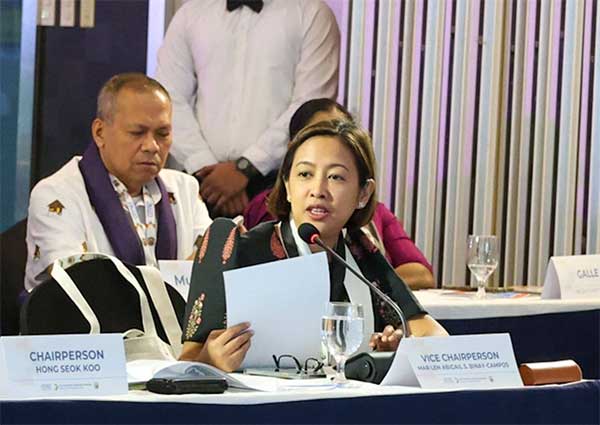
Binay made the remarks during her visit to Iloilo City as a resource person on urban management for the ongoing 44th CityNet Executive Committee Meeting hosted by the city.
The mayor noted that under the current Code, the requirements for barangay treasurers are the same across all municipalities, regardless of whether they are classified as fifth-class or highly urbanized.
Binay proposed a segmented approach to the requirements for barangay treasurers, factoring in a municipality’s classification and budget size.
“Higher-class municipalities should have stricter standards to ensure proper management of taxpayer money,” she said.
She emphasized that individuals handling public funds must be qualified, with strict recording and accounting protocols in place.
Under the LGC, barangay treasurers must meet the following qualifications: they must be of legal age, a qualified voter, an actual resident of the barangay, and not a member of the Sangguniang Barangay or a relative of the Punong Barangay (barangay captain) up to the fourth civil degree of consanguinity or affinity.
The Code, however, does not require barangay treasurers to have accounting or finance degrees.
Binay also raised concerns about political influences on barangay treasurers, noting that treasurers risk being replaced if their political affiliation differs from that of the barangay captain and the majority of the Sangguniang Barangay members.
“There is no continuity or accountability, even though they are managing millions of pesos in taxpayer money,” she said.
She further criticized salary grade restrictions that hinder local governments from attracting highly qualified personnel.
“Due to salary grade limitations, we cannot compete with the private sector. We are restricted by the salary grade cap,” Binay explained.
Currently, the Punong Barangay has a salary grade of 14, while Sangguniang Barangay Members, Barangay Secretaries, and Barangay Treasurers are assigned a salary grade of 10. Any adjustments to these salaries cannot exceed the basic salary prescribed for the corresponding salary grade in their city or municipality.
No comments yet
Be the first to share your thoughts!

ILOILO CITY – The successful modernization of Ninoy Aquino International Airport (NAIA) and the concession of Mactan-Cebu International Airport (MCIA) could serve as the blueprint for the long-awaited upgrade of Iloilo International Airport, the Public-Private Partnership (PPP) Center said. PPP Center Executive Director Rizza Blanco-Latorre said the government is revisiting airport

ILOILO CITY – A lawmaker pushing for nuclear energy development in the Philippines said Wednesday, July 29, that Western Visayas would gain cheaper electricity and a more reliable supply if the country taps the technology. Pangasinan 2nd District Rep. Mark Cojuangco, who chairs the House of Representatives committee on nuclear

ILOILO CITY – Strengthening responsible parenthood and ensuring that young people have access to accurate, age-appropriate information remain critical to reducing adolescent pregnancy in Western Visayas, the Commission on Population and Development in Western Visayas (CPD-6) said. CPD-6 Director Harold Alfred Marshall said on July 30 that the region’s reported 9.8