
UPV prof’s work included in Science Advances publications on climate change intervention research
Dr. Johnrev Guilaran of the Division of Social Sciences, College of Arts and Sciences, University of the Philippines Visayas (UPV) is part of a team of 260 researchers across the globe whose research on climate change intervention was published on Science Advances. Science Advances published the team’s research titled “Addressing climate change with behavioral science:

By Staff Writer
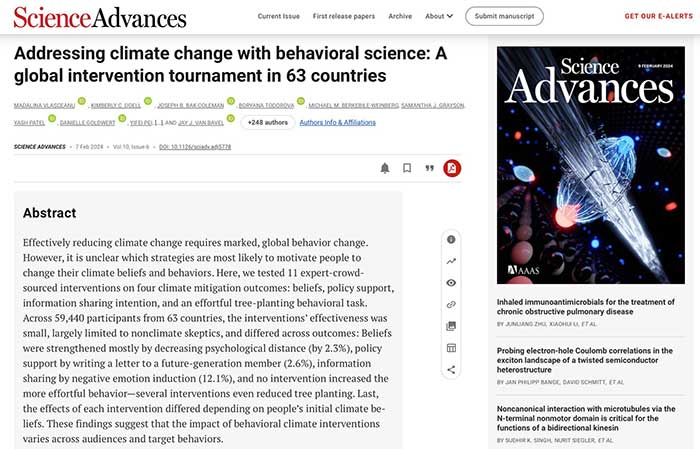
Dr. Johnrev Guilaran of the Division of Social Sciences, College of Arts and Sciences, University of the Philippines Visayas (UPV) is part of a team of 260 researchers across the globe whose research on climate change intervention was published on Science Advances.
Science Advances published the team’s research titled “Addressing climate change with behavioral science: A global intervention tournament in 63 countries” recently.
Science Advances is an open-access journal of the American Association of the Advancement of Science and one of the top journals globally.
Guilaran is the only member of the team from a Philippine university. The study was led by researchers from New York University.
The team tested 11 expert-crowd-sourced interventions on four climate mitigation outcomes: beliefs, policy support, information sharing intention, and an effortful tree-planting behavioral task.
A total of 59,440 people from 63 countries took part in the research, according to Science Advances. The details of the study can be found on https://www.science.org/doi/10.1126/sciadv.adj5778. (Mr. Carlson Alelis, IPO)
Article Information
Comments (0)
LEAVE A REPLY
No comments yet
Be the first to share your thoughts!


