
Trapped in a solar panel, monitor lizard rescued in Manapla
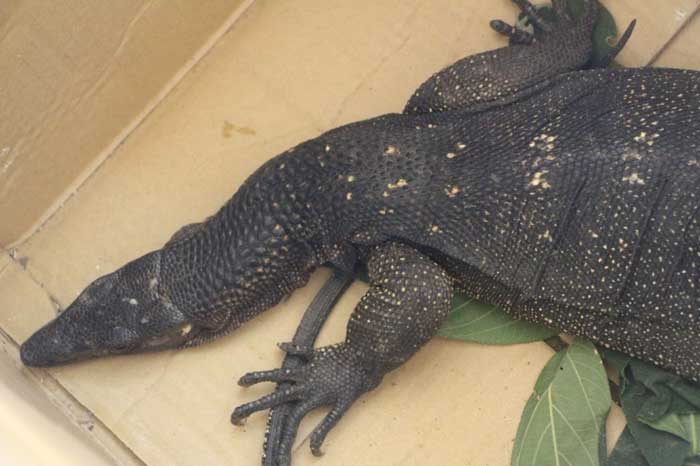
A juvenile monitor lizard of the Varanus nuchalis species, measuring 122 centimeters (4 ft.), was turned over to the field office of the Department of Environment and Natural Resources (DENR) in Cadiz City last July 18, 2023.
The lizard was found inside Isla Sol Solar Power Plant in the municipality of Manapla, Negros Occidental.
Personnel of the local government unit of Manapla led by Municipal ENR Officer Victor Lapidez said the animal got trapped in one of the solar panels inside the plant.
They later turned over the lizard to DENR Community ENR Office in Cadiz City under CENRO Mamad T. Gandarosa, Jr.
There were no injuries found during the initial physical examination by CENRO-Cadiz Conservation and Development Section Chief Carolyn A. Grijaldo. Executive Director Lisa Paguntalan of the Philippine Biodiversity Conservation Foundation, Inc. readily lend her expertise to DENR CENRO Cadiz in identifying the monitor lizard.
Monitor lizards in the Philippines number to eleven endemic species, including the three known fruit-eating monitor species in the world, namely: Varanus mabitang, V. bitatawa and V. olivaceus.
Varanus nuchalis is also called the Spiny Necked Water Monitor because of its “very large nuchal (back of the neck) scales which are larger than any scutes (bony external plate) of the head”, according to Günther (1872). Like other monitors, V. nuchalis have forked tongues like snakes, which they use to accurately locate a prey’s scent.
They are listed as Near Threatened (NT) under the International Union for Conservation of Nature’s (IUCN) Red List of Threatened Species. Moreover, V. nuchalis’ population is on a decreasing trend due to poaching for its skin, pet trade, bush meat and habitat loss. It is endemic in the Philippines and are found in the island of Negros, Panay, Masbate, Cebu and Ticao. They are found in the mangroves and lowland forests.
“Our wildlife is part of the ecosystems that support our lives thus, protecting them equates to protecting the sustainability of our forest ecosystems from which we derived our food and provide us with clean air and water, among many others,” said DENR 6 Regional Executive Director Livino B. Duran.
“We commend the efforts of LGU Manapla in turning over the monitor lizard as we hope to strengthen our coordination efforts with all other stakeholders – all to sustain our rich biodiversity,” he added. (DENR-6)
Comments (0)
LEAVE A REPLY
No comments yet
Be the first to share your thoughts!


