Starting Small, Reaching Big
“It was worthwhile,” said 64-year-old Nestor Barraca Sr. from San Jose, Batangas, recalling his journey before he attained a thriving junkshop business. With nothing but a bicycle and sheer determination, Nestor began collecting scraps in 1982. Nestor, originally from Quezon, was encouraged by his cousin to work at a sari-sari store in Batangas at 17.

By Staff Writer
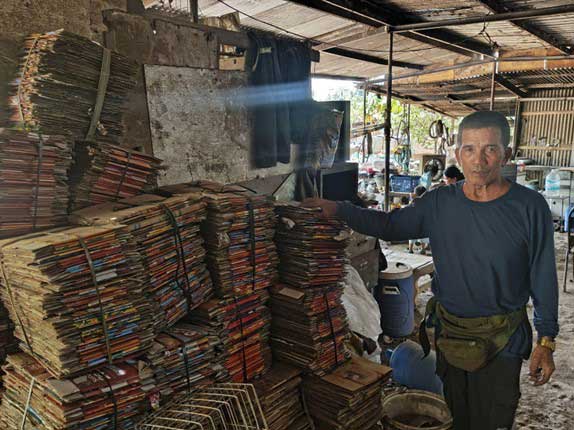
“It was worthwhile,” said 64-year-old Nestor Barraca Sr. from San Jose, Batangas, recalling his journey before he attained a thriving junkshop business.
With nothing but a bicycle and sheer determination, Nestor began collecting scraps in 1982.
Nestor, originally from Quezon, was encouraged by his cousin to work at a sari-sari store in Batangas at 17. When he turned 19, he found a job as a dishwasher in a canteen, where he met his wife.
When their first child was born, he worked in a rice field, cutting rice stalks and clearing grass, earning PHP 75.00 a day under the scorching sun. Later on, as their family grew, he decided to work in a restaurant to make ends meet. He got himself a bicycle to ease the challenge of commuting.
Eventually, during his daily bike rides, he began going door-to-door to collect bottles, aware that his salary from the restaurant was insufficient. After seeing its potential, he quit his job to focus on this new venture.
From his income, he added a sidecar to his bike. By 1988, he had acquired a motorcycle with a sidecar, and by 2000, he managed to expand into five bikes with a sidecar.
However, it is not all sunshine and butterflies; he still remembers being imprisoned for a day after unknowingly buying stolen scraps; fortunately, the true culprits were eventually caught.
At one point, he faced financial losses due to a sudden drop in the price of scraps. But instead of sulking, he doubled his efforts to recover the losses and keep his business going.
He began with a capital of PHP 500.00 and has now increased it to PHP 400,000.00. When his capital was insufficient, he would acquire a loan from CARD SME Bank, a thrift bank he became a client of in 2013.
He accepts bottles, cardboard, steel, aluminum, copper, plastic, tin cans, and roof covers.
“I want all of us in the family to succeed; therefore, I teach my relatives all my knowledge in handling this business so that we can all succeed together,” he said.
Currently, all his siblings run their junk shops. His child, who also owns a junk shop, occasionally assists him in his business.
Aside from the generated income, his business made a significant contribution to reducing plastic and other materials that are often discarded, adding to environmental harm and pollution. By reusing and recycling the materials considered waste by many, Nestor helps minimize the energy consumption needed to produce new products, helping to combat climate change.
With financial support from CARD SME Bank, coupled with hard work, Nestor Barraca managed to continue collecting scraps while contributing to various Sustainable Development Goals (SDGs), such as responsible consumption and production, life on land, life below water, and climate action.
His advice to others who started with a dream of having a business is not to be afraid of making a step, “Take that small step, and eventually, as you look back, you will find yourself a step closer to your dreams,” he concluded.
Article Information
Comments (0)
LEAVE A REPLY
No comments yet
Be the first to share your thoughts!