
SEARCA seminar advocates inclusive blue economy policies to combat coastal poverty
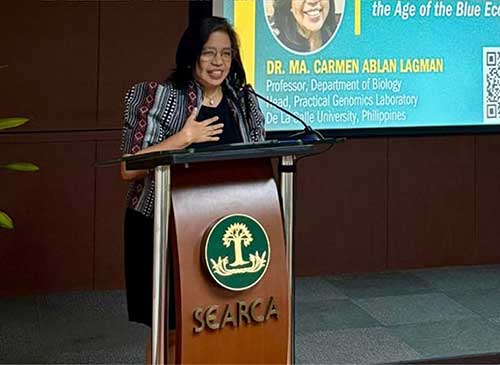
LOS BAÑOS, Philippines—In a seminar held on 20 August 2025, the Southeast Asian Regional Center for Graduate Study and Research in Agriculture (SEARCA) highlighted the pressing need for coastal communities in Southeast Asia to be integrated into national and local development strategies through the blue economy.
This event, part of the Agriculture and Development Seminar Series (ADSS), featured Dr. Ma. Carmen Ablan-Lagman from De La Salle University (DLSU), who presented her insights on rethinking coastal poverty amid emerging economic opportunities.
Ablan-Lagman emphasized that Southeast Asia’s oceans possess immense potential for sustainable growth that is both inclusive and equitable. Titled “From Margins to Mainstream: Rethinking Coastal Poverty in the Age of the Blue Economy,” her presentation underscored the necessity for interdisciplinary collaboration in developing innovative solutions for these communities.
“Critical thinking is very hard to develop in a room full of people from the same discipline,” noted Dr. Lagman, challenging attendees—students, researchers, and government officials alike—to embrace diverse viewpoints. She highlighted that while the ocean economy in the Philippines has been expanding at nearly double the national growth rate of 9.9%, its contribution to the country’s gross domestic product (GDP) remains alarmingly low at only 3.6%–3.9%.
Lagman pointed out that many coastal residents in the region continue to face persistent poverty, vulnerable to low incomes and unpredictable climate impacts. “Despite being situated next to rich marine resources, small-scale fishers and aquaculture workers remain largely excluded from the development process,” she said, citing structural and multi-generational aspects of poverty driven by economic marginalization and policy neglect.
To address these systemic challenges, she proposed actionable strategies for fostering a transformative blue economy. Her recommendations included enhancing value chain processes, implementing certifications to improve product quality and market access, and leveraging digital platforms to connect fishers directly with consumers, thereby reducing reliance on exploitative intermediaries.
Lagman also urged diversification of aquaculture and seaweed products to broaden market opportunities. “Sustainable innovations must not only minimize environmental impact but also be appealing and profitable for coastal households,” she stated, reinforcing the importance of financial viability to successful development interventions.
The seminar concluded with a passionate call to action for young scholars and practitioners from various backgrounds to leverage their expertise in reimagining the future of Southeast Asia’s coastal communities. Dr. Lagman reiterated the need for interventions to be reflective of local realities, underscoring the importance of inclusive policies and innovative thinking in the pursuit of sustainable development.
The SEARCA ADSS serves as a vital platform for exchanging ideas and sharing knowledge on agricultural and rural development, fostering dynamic discussions both within and beyond the Los Baños Science Community.
Comments (0)
LEAVE A REPLY
No comments yet
Be the first to share your thoughts!
Related Articles

BIR removes VAT on system loss charge
Electricity consumers are set to get a small but direct reduction in their power bills after the Bureau of Internal Revenue removed the 12% value-added tax on the allowable system loss charge. Under Revenue Memorandum Circular No. 97-2026 issued Sept. 14, the BIR classified the allowable system loss within the Energy Regulatory Commission-approved cap as

Ajuy opens PHP 130 million business park, barangay hall
ILOILO CITY — The municipality of Ajuy inaugurated two major infrastructure projects Thursday, Sept. 10, aimed at strengthening local economic activity and improving community services. The projects include the PHP 130 million Ajuy Business Park and a PHP 4.1 million multipurpose hall in Barangay Puente Bunglas that will also serve as

Maybe it’s time we let women run the business
For generations, we have been told that leadership must look a certain way. It must be forceful, commanding and almost always male. A decisive man is called a strong leader. A decisive woman is called difficult. A man who protects his time is disciplined; a woman who does the same is