
SEARCA conducts Lego education robotics for smart agriculture
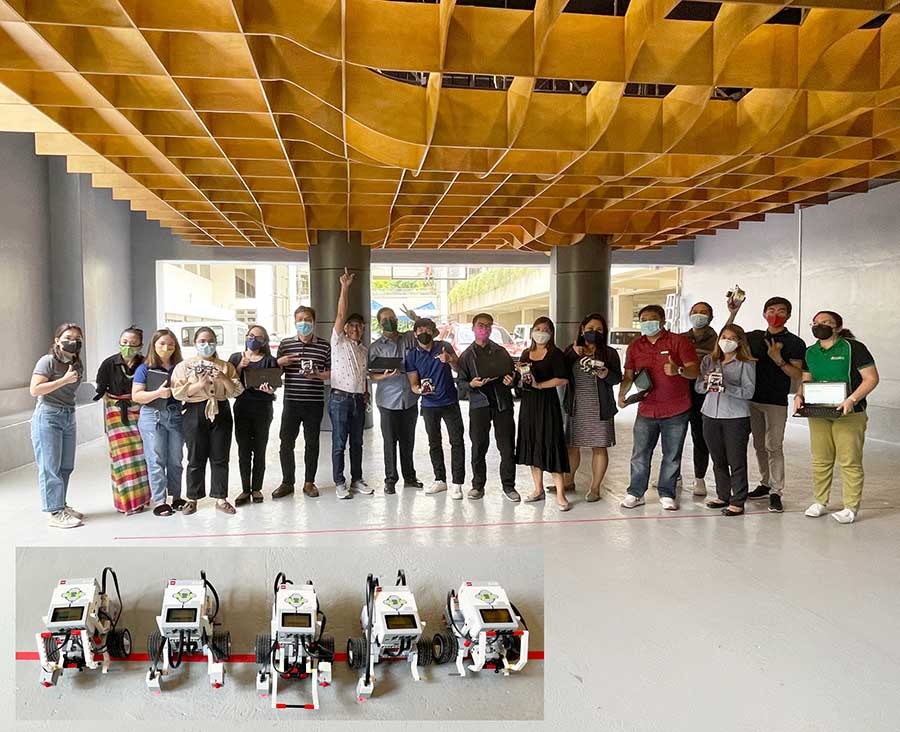
The Southeast Asian Regional Center for Graduate Study and Research in Agriculture (SEARCA) organized the maiden run of its InnovEIGhts ideation session on Lego education robotics for smart agriculture last April 7.
Dubbed “Brewing Education and Creativity AGRI 4.0,” the ideation session included training in the basics of building, programming, and operating Lego as well as a demo of the proper usage of the accompanying software. It also introduced the participants to the Snapmaker and DOBOT robotic arm, both of which are housed in the SEARCA Hub for Agriculture and Rural Innovation for the Next Generation (SHARING).
Titled “Brewing Education and Creativity AGRI 4.0,” the ideation session was the first event held at the SHARING Café.
SEARCA Director Dr. Glenn B. Gregorio said the SHARING Café is an interactive component of the SHARING innovation spaces that aim to provide a creative learning experience geared towards Agriculture 4.0 in Southeast Asia.
He added that the SHARING Café is designed as an innovative venue for “play-to-learn” and “learn-to-play” activities for guests and fun learning modules for K-12 students in the beginner, intermediate, and advanced levels and even the parents.
“For its first run, SEARCA’s InnovEIGhts ideation session on Lego education robotics engaged the Center’s staff with the long view that they will become the focal and in-house resource persons in Lego education robotics for their respective departments and units,” Dr. Gregorio said.
The participants comprised five groups, each equipped with its own robotic Lego set (EV3Lab), which they built and programmed by themselves. The Lego education sets used were WEDO 2.0 and EV3Lab. WEDO 2.0 was developed to engage and motivate elementary students’ interest in learning science and engineering subjects and their application in smart agriculture. EV3Lab is a third-generation robotics kit in Lego’s Mindstorm line.
A Director’s Cup was held to test their robots’ agility in a race at the SHARING Open Learning Space. The first team that successfully programmed their machine to make it from the starting point and back bagged the prize.
Felta Multimedia Inc., official distributor of Lego education materials and robotics in the Philippines, implemented the training. Felta will also certify the participants as Lego education trainees equipped to instruct interested learners.
Glenn N. Baticados, SEARCA Program Head for Emerging Innovation for Growth, challenged the trainees to craft proposals or projects relevant to their respective departments, that would encourage innovative minds to use the world-class facilities and tools of the SHARING innovation spaces.
SEARCA will hold the second run of the Lego education robotics for smart agriculture on April 21, 2022 with participants from grade school to collegiate level.
Comments (0)
LEAVE A REPLY
No comments yet
Be the first to share your thoughts!
Related Articles

Iloilo desalination plant eyes partial energization by December 2027
ILOILO CITY — Iloilo City could get an additional 30 million liters per day (MLD) of water by December 2027, when Metro Pacific Iloilo Water Inc. (MPIW) plans to partially energize its 66.5 MLD desalination plant in Barangay Ingore, La Paz district. MPIW Chief Operating Officer Angelo David Berba said Thursday,

WATER DEAL SEALED: MPIW, WeeComm forge partnership for new transmission pipeline serving Emerald Estates
ILOILO CITY – Metro Pacific Iloilo Water Inc. (MPIW) and Iloilo Southprime Developers Inc., operating as WeeComm, formally signed a memorandum of agreement (MOA) for the construction of a new water transmission pipeline connecting Mandurriao Plaza to Emerald Estates Subdivision in Barangay Cagbang, Oton. The agreement was signed by MPIW Chief Operating Officer Angelo David

Cebu power deficit drags Visayas grid into repeated alerts
ILOILO CITY — Cebu’s simulated 422-megawatt shortfall during the evening peak has emerged as the weak link in the Visayas grid, forcing the island to draw electricity from four separate grids at the same time to keep supply and demand in balance. Engr. Keelvin Dajao of the Department of Energy