
Philippines must build 7,000 classrooms yearly until 2040
By Francis Allan L. Angelo
By Francis Allan L. Angelo
The Philippines must construct between 6,000 and 8,000 new classrooms annually for the next decade and a half to resolve a deep-seated infrastructure backlog and accommodate future educational needs, according to new research from the Philippine Institute for Development Studies (PIDS).
This aggressive building campaign, estimated to cost between PHP 18 billion and PHP 24 billion yearly, is essential to tackle the severe overcrowding that plagues the nation’s public school system.
Speaking at a recent forum on education policy, PIDS Senior Research Fellow Dr. Michael Ralph Abrigo, lead author of two comprehensive studies on the matter, emphasized that solving this perennial crisis requires more than just funding; it demands a strategic, long-term vision.
“If education is something important to us, as a nation, we should be able to put our heads together to address this issue,” Abrigo stated during the event hosted by Centro Escolar University.
The call to action is based on findings from two PIDS papers, “Low Fertility, Ageing Buildings, and School Congestion in the Philippines” and “Are We Missing Out on the Demographic Dividend? Trends and Prospects,” which collectively paint a complex picture of demographic tailwinds, infrastructure headwinds, and immense economic potential.
STATE OF CONGESTION
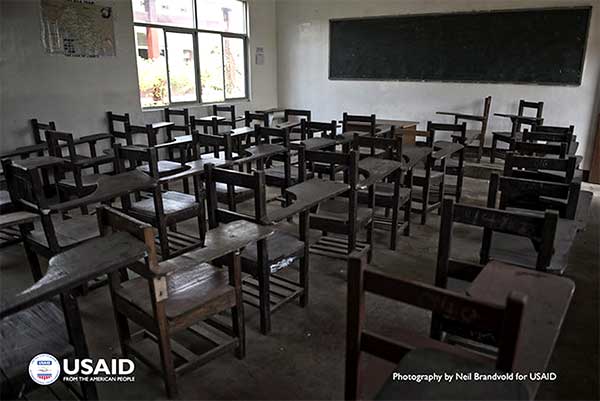
The problem of classroom congestion in the Philippines remains acute, despite some progress.
Average public school class sizes are approximately double those in developed nations.
In some local schools, class sizes can swell to over 60 students in a single room, more than three times the average in industrialized countries.
A 2021 assessment revealed a nationwide deficit of about 108,000 classrooms needed to meet a benchmark of 50 students per class.
The vast majority of this shortage, numbering 70,187 classrooms, is concentrated at the elementary level.
This overcrowding is particularly severe in high-density urban areas and specific regions.
The National Capital Region (NCR), CALABARZON, SOCCSKSARGEN, and the Bangsamoro Autonomous Region in Muslim Mindanao (BARMM) consistently report the highest median student-to-classroom ratios.
In 2021, the situation in Metro Manila was especially dire.
In NCR’s Northern Manila District, a staggering 90% of public elementary school students were in congested classrooms.
Neighboring districts were not far behind, with Southern Manila at 76.8% and Eastern Manila at 60.1%.
The strain extends to adjacent provinces, including Rizal (66.0%) and Cavite (57.7%), highlighting a regional infrastructure crisis.
WHY THE BACKLOG PERSISTS
The PIDS studies identified several interconnected factors, or “headwinds,” that have contributed to the chronic classroom shortage.
- Limited and Mismatched Funding
While government investment in school buildings grew until 2017, peaking at PHP 128.6 billion, appropriations have since declined, particularly during the COVID-19 pandemic.
Historically, these investments were often insufficient to keep pace with rising enrollment, serving mainly to replace dilapidated facilities rather than expand capacity.
- Aging Buildings and Natural Wear
School buildings, like all physical infrastructure, deteriorate over time.
A significant portion of the country’s public school rooms have already exceeded their government-assigned useful life.
According to a 2023 inventory, 80.2% of wooden school rooms, 51.7% of mixed wood-and-concrete structures, and 24.5% of concrete buildings were past their expected lifespan.
Projections show that without intervention, the situation will worsen significantly by 2040, with about 14.5% of current rooms becoming condemned and only 18.6% remaining in good condition.
- Natural and Man-Made Calamities
The Philippines’ geographic location along the Pacific Ring of Fire and the Western Pacific typhoon belt makes it highly vulnerable to natural disasters that wreak havoc on school infrastructure.
The studies highlight a striking pattern: newly constructed classrooms in areas hit by devastating storms like Typhoon Ompong (2018), Rolly (2020), and Odette (2021) were already in need of major repair or designated for condemnation by 2023, demonstrating the immense toll of these calamities.
- Severe Bottlenecks in the Project Cycle
The process of building a public classroom is notoriously slow, averaging around three years from budget appropriation to actual construction.
“Currently, classroom construction procedures are lengthened by phased budgeting, site verification, bidding, and hazard assessment processes,” Abrigo noted.
The research found that a remarkable 60% of project delays and bottlenecks occur in the planning phase alone.
These planning issues include:
- Coordination Failures: Information silos and poor coordination between the Department of Education (DepEd), the Department of Public Works and Highways (DPWH), and the National Economic and Development Authority (NEDA) create significant friction.
- Information Mismatch: Agencies use different indicative costs for construction—DPWH at PHP 3.5 million per classroom versus DepEd at PHP 2.5 million—leading to planning discrepancies.
- Site Unavailability: A persistent hurdle is the lack of available school sites with proper land titles, especially in dense and expensive urban centers.
- Incomplete Documentation and Red Tape: Complicated documentary requirements, such as the “Implementation Readiness” criteria, often result in high disapproval rates for proposed projects.
- Prioritization of New Construction Over Maintenance
Funding and policy have historically favored building new classrooms over maintaining existing ones.
This has led to the neglect of other essential facilities, such as Water, Sanitation, and Hygiene (WASH) amenities.
Interviewees in the study shared that these neglected facilities often fall into disrepair or are repurposed as makeshift classrooms to cope with shortages, further degrading the learning environment.
WINDOW OF OPPORTUNITY
Amidst these challenges, a significant demographic shift offers a “tailwind” that could help ease the pressure on the education system.
The Philippines’ total fertility rate (TFR) recently fell to 1.9 births per woman, which is below the 2.1 replacement level needed to maintain population size.
This decline is projected to lead to a decrease in the school-age population across most of the country through 2040 and beyond, with the notable exception of BARMM, where enrollment is expected to continue rising.
“Per the PSA projections, if our Total Fertility Rate drops to around 1.7 by the 2050s, our population will start to decline,” Abrigo explained. “With fewer children entering school, we’ll need fewer classrooms and teachers.”
This demographic trend presents a crucial window to address the existing backlog.
However, PIDS warns that this tailwind alone is not a panacea.
When the accelerated wear and tear of aging buildings is factored in, the classroom deficit is projected to remain substantial, estimated at between 100,000 to 122,000 classrooms by 2040.
This underscores the urgent need for continuous and strategic infrastructure investment.
STRATEGIC PLANNING, SYSTEMIC REFORM
To truly solve the crisis, PIDS advocates for a multi-pronged approach that moves beyond simply allocating funds.
“DepEd is not in the business of constructing buildings. Their mission is improving education, and classrooms are just one part of that,” Abrigo asserted.
The core recommendation is the creation of a long-term School Building Construction Masterplan.
This masterplan should be dynamic and data-driven, using regularly updated enrollment and supply projections to direct resources where they are most needed and to build classrooms before demand surges.
“There should be a very strategic project management. It’s not just about the budget per se,” Abrigo added.
Beyond construction, the studies propose exploring alternative solutions to maximize existing resources.
These include implementing mechanisms for sharing excess classrooms between nearby schools and adopting flexible schedules.
The government is also urged to encourage greater private sector participation through public-private partnerships (PPPs) in construction or by expanding education service contracting and voucher programs that allow public students to enroll in private schools.
DEMOGRAPHIC DIVIDEND
The classroom crisis is inextricably linked to the Philippines’ larger economic future and its ability to harness the “demographic dividend”—the potential for accelerated economic growth that arises from having a larger share of working-age people relative to dependents.
PIDS research shows the Philippines has already benefited from this transition.
Between 1990 and 2015, the first demographic dividend (from a favorable age structure) contributed an average of 0.5 percentage points to annual growth in consumption per person.
More importantly, the second demographic dividend—driven by behavioral changes like greater investment in human capital that boosts productivity—contributed a much more substantial 2.3 percentage points annually.
This second dividend is not temporary; its gains can be sustained for over a century, but it is not automatic.
“The demographic dividend isn’t automatic — we must invest in human capital through education, health, and employment to ensure our future workforce is ready,” said Abrigo.
Fixing the classroom shortage is a direct investment in this future.
Ensuring children learn in a conducive environment is fundamental to building the human capital needed to power long-term, sustainable growth.
However, this imperative comes with a fiscal warning.
As the population ages, the burden on public resources, particularly for pensions and healthcare, will grow, potentially leading to unsustainable public debt.
PIDS simulations project that under a business-as-usual scenario, public debt could rise to 80% of the country’s primary income by 2030 and breach 100% by 2060.
This creates a critical policy challenge: the country must invest heavily now to reap the dividend, while simultaneously preparing for the fiscal pressures of an aging society.
The solution, PIDS suggests, lies in matching investments and social programs with smart revenue-generating reforms to ensure a prosperous and fiscally stable future.
Comments (0)
LEAVE A REPLY
No comments yet
Be the first to share your thoughts!


