
‘Odette’ affects 2.2M workers, over 600,000 in Region 6
By Francis Allan L. Angelo
By Francis Allan L. Angelo
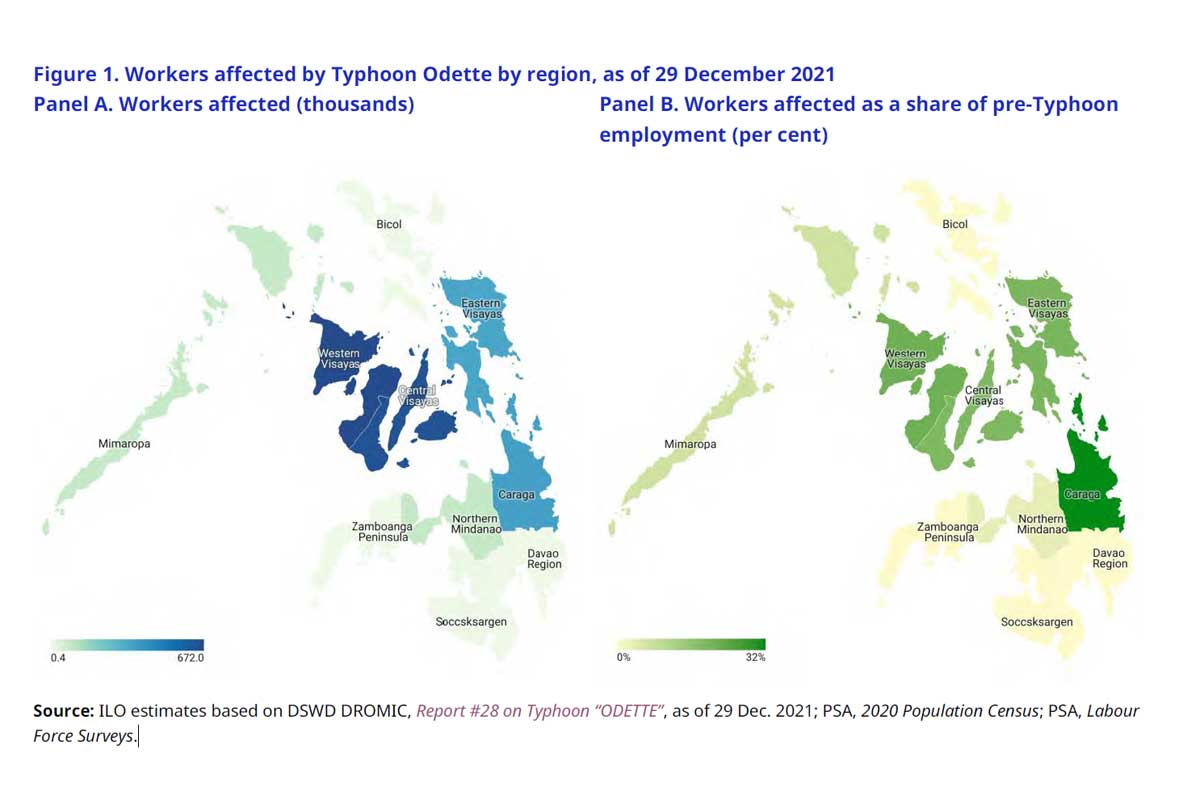
More than 600,000 of the over 2.2 million workers affected by Typhoon Odette (international name: Rai) were in Western Visayas.
This is according to the rapid assessment conducted by the International Labor Organization (ILO) in December 2021. Odette barreled through the country on Dec 16, 2021.
In a press release on Friday, the ILO noted that while Odette hit several regions across the country, the impact on employment was varied.
“Amongst the regions hardest hit were Western Visayas that saw 21% (672,000) of the workforce affected, Eastern Visayas with 19% (343,000); and Central Visayas with 18% (643,000). Meanwhile, in Caraga (Region XIII), nearly one-third of the region’s entire workforce (363,000) was impacted,” it added.
By comparison, Odette directly affected around one-fifth of all workers in each of the other three most impacted regions: Western Visayas (21 per cent), Eastern Visayas (19.3 per cent) and Central Visayas (18.8 per cent).
The ILO assessment also noted that the “devastation of Typhoon Odette risks exacerbating pre-existing labour market challenges for various vulnerable groups.”
For example, of the total affected workers, nearly 839,000 (38 per cent) are women. Before the destruction of Typhoon Odette, around three in five of these impacted women workers were employed in agriculture, wholesale and retail trade or domestic work – sectors where jobs typically are lower paid and less productive.
Young people and older workers, both of whom face distinct age-related employment challenges, account for an estimated 297,000 and 378,000, respectively, of the total impacted workers.
Even before Odette’s onslaught, many of the affected workers were self-employed with limited income security and access to social protection, leaving them highly vulnerable in circumstances of a negative shock.
“The destruction of Odette on jobs and livelihoods underscores this vulnerability. An estimated 863,000 (39 per cent) of the affected workers are self-employed as an own-account worker or contributing family worker. In both Caraga and Eastern Visayas, the estimated share of own-account and contributing family workers among the employed women and men impacted by the disaster is considerably higher at 48 per cent and 47 per cent, respectively,” the ILO added.
IMPACT AREAS
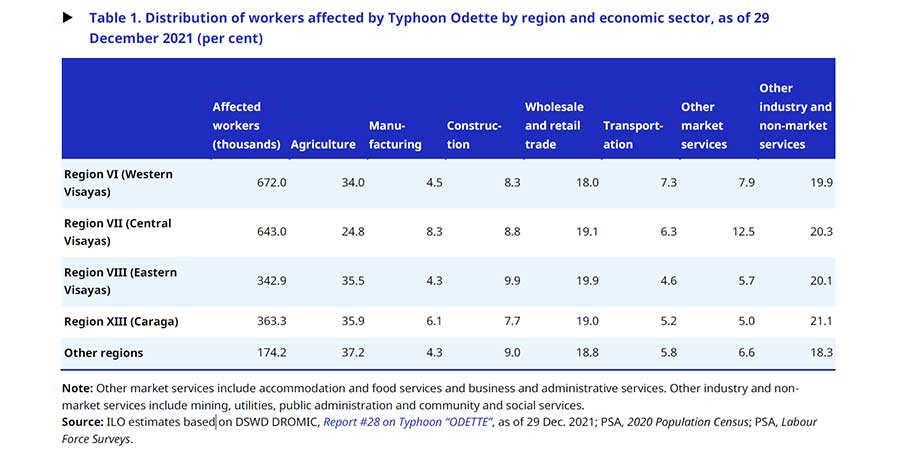
Although Typhoon Odette ravaged parts of 10 different regions, “the impact on employment has varied by economic sector, reflecting in part the unique structure of each regional economy.
In Western Visayas, 34 percent of the 672,000 affected workers are estimated to be employed in agriculture with an additional 18 per cent and 7.3 per cent concentrated in trade and transportation, respectively.
By comparison, in Central Visayas, a significantly lower proportion of the affected workers is employed in agriculture (24.8 per cent), although manufacturing (8.3 per cent) and other market services (12.5 per cent) account for a relatively greater share.
In Caraga, agriculture employs a high percentage (35.9 per cent) of the 363,000 affected workers, but a comparatively lower share is employed in construction (7.7 per cent) and other market services (5 per cent).
In Eastern Visayas, women and men working in trade and construction comprise nearly one-third of the 343,000 affected workers.
Comments (0)
LEAVE A REPLY
No comments yet
Be the first to share your thoughts!


