Guimaras Inflation Rises to 2.8% in December 2024
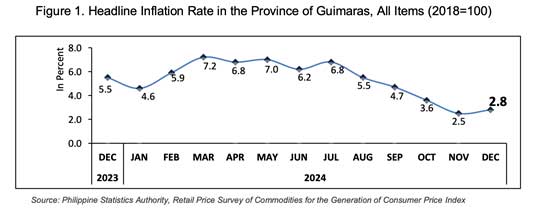
The inflation rate in Guimaras increased to 2.8% in December 2024 from 2.5% in November 2024, bringing the province’s average inflation for January to December 2024 to 5.3%, according to the Philippine Statistics Authority (PSA). Provincial Statistics Officer Nelida B. Losare attributed the December inflation hike to a significant increase in food and non-alcoholic beverage

By Staff Writer
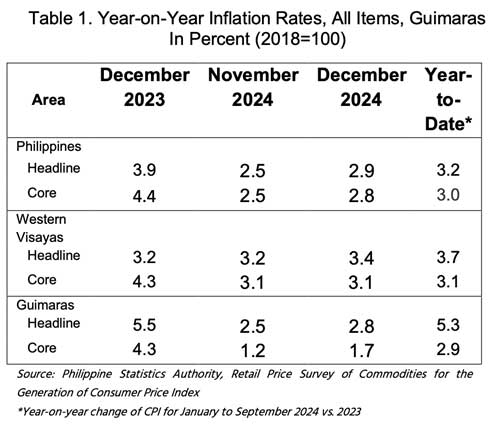
The inflation rate in Guimaras increased to 2.8% in December 2024 from 2.5% in November 2024, bringing the province’s average inflation for January to December 2024 to 5.3%, according to the Philippine Statistics Authority (PSA).
Provincial Statistics Officer Nelida B. Losare attributed the December inflation hike to a significant increase in food and non-alcoholic beverage prices, which rose by 4.6% from 2.4% in November 2024.
“The rapid annual price change in transportation at 2.1% in December from -0.9% in November, and in clothing and footwear at 2.4% from 0.3% the previous month, also contributed to the inflation uptick,” Losare explained.
Food items accounted for 77.9% of the inflation increase in December, while transportation and clothing and footwear contributed 14.7% and 6%, respectively.
The price surge was particularly notable in items like leafy or stem vegetables, which posted a 24.6% inflation rate from -1.3% in November, gasoline, which adjusted to -4.5% from -11%, and garments for women and girls, which rose to 2.7% from -0.1%.
Inflation also increased in personal care and miscellaneous goods and services, which climbed to 1.5% in December from 1.2% in November. Furnishings, household equipment, and routine maintenance improved slightly to -0.3% from -0.5%.
On the other hand, slower inflation rates were observed in several categories, including:
- Alcoholic beverages and tobacco: 1.5% from 3.0%
- Housing, water, electricity, gas, and other fuels: 2.6% from 6.6%
- Health: 2.7% from 3.8%
- Recreation, sport, and culture: 5.7% from 6.0%
- Restaurants and accommodation services: -5.7% from -0.5%
Meanwhile, three categories retained their inflation rates: information and communication at 3.3%, education services at 0.0%, and financial services at 0.0%.

The December inflation in Guimaras was heavily influenced by three major commodity groups.
Food and non-alcoholic beverages led with a 77.9% contribution, primarily driven by a sharp 17.3% increase in rice prices.
Housing, water, electricity, gas, and other fuels contributed 13.9%, with a notable 7.6% inflation rate for electricity from various sources.
Transportation added 4.9%, propelled by a 42.2% inflation rate in passenger transport by sea and inland waterways.
Losare also highlighted a rise in core inflation, which excludes volatile food and energy prices, to 1.7% in December from 1.2% in November 2024. This was lower than the 4.3% core inflation recorded in December 2023 (Table 1).
REGIONAL TRENDS
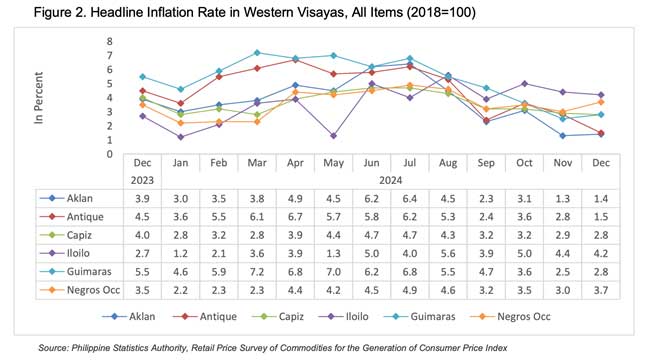
Western Visayas provinces displayed varied inflation trends in 2024.
Aklan and Antique saw consistent declines, with Aklan’s inflation dropping from 3.9% in December 2023 to 1.4% in December 2024, and Antique decreasing from 4.5% to 1.5%.
Capiz followed a gradual downward trend, while Iloilo and Guimaras experienced more volatile fluctuations. Negros Occidental ended the year at 3.7%, reflecting similar instability.
Losare elaborated that Guimaras’ Consumer Price Index (CPI) reached 134.1 in December 2024, meaning a typical household needed PHP 1,341 to purchase the same basket of goods and services worth PHP 1,000 in 2018.
“The Purchasing Power of the Peso (PPP) in Guimaras stood at 0.75 in December 2024, reflecting a slight devaluation from 0.76 in November. The PPP in December 2023 was higher at 0.77,” Losare noted
Article Information
Comments (0)
LEAVE A REPLY
No comments yet
Be the first to share your thoughts!