
FDI net inflows at US$548 million in March 2023
Foreign direct investment (FDI) recorded US$548 million net inflows in March 2023, lower by 30.7 percent than the US$792 million net inflows in the same month in 2022.1, 2 The decline resulted from lower net inflows across all major FDI components amid investor concerns over subdued global growth prospects (Figure 1).[3] Equity capital placements during the month

By Staff Writer
Foreign direct investment (FDI) recorded US$548 million net inflows in March 2023, lower by 30.7 percent than the US$792 million net inflows in the same month in 2022.1, 2
The decline resulted from lower net inflows across all major FDI components amid investor concerns over subdued global growth prospects (Figure 1).[3]

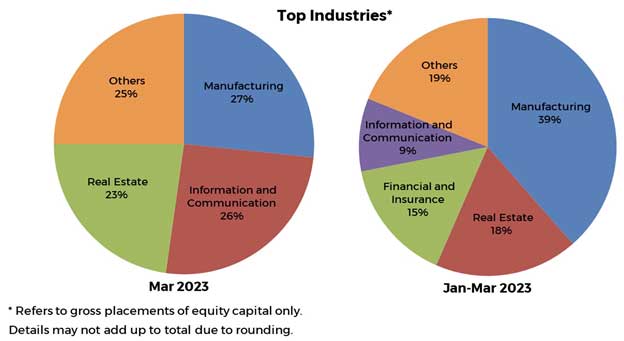
Equity capital placements during the month originated mostly from Singapore, Japan, and the United States. These were directed mainly to the 1) manufacturing; 2) information and communication; and 3) real estate industries.
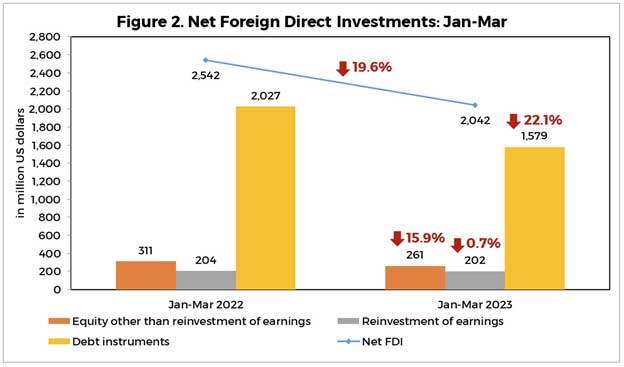
For the first quarter of 2023, FDI net inflows likewise decreased by 19.6 percent to US$2.0 billion from the US$2.5 billion net inflows recorded in the comparable period last year (Figure 2).
1 The BSP statistics on FDI are compiled based on the Balance of Payments and International Investment Position Manual, 6th Edition (BPM6). FDI includes (a) investment by a non-resident direct investor in a resident enterprise, whose equity capital in the latter is at least 10 percent, and (b) investment made by a non-resident subsidiary/associate in its resident direct investor. FDI can be in the form of equity capital, reinvestment of earnings, and borrowings.
2 The BSP FDI statistics are distinct from the investment data of other government sources. BSP FDI covers actual investment inflows. By contrast, the approved foreign investments data that are published by the Philippine Statistics Authority (PSA), which are sourced from Investment Promotion Agencies (IPAs), represent investment commitments, which may not necessarily be realized fully, in a given period. Further, the said PSA data are not based on the 10 percent ownership criterion under BPM6. Moreover, the BSP’s FDI data are presented in net terms (i.e., equity capital placements less withdrawals), while the PSA’s foreign investment data do not account for equity withdrawals.
[3] Net investments in debt instruments consist mainly of intercompany borrowing/lending between foreign direct investors and their subsidiaries/affiliates in the Philippines. The remaining portion of net investments in debt instruments are investments made by non-resident subsidiaries/associates in their resident direct investors, i.e., reverse investment.
Article Information
Comments (0)
LEAVE A REPLY
No comments yet
Be the first to share your thoughts!


