
Experts Recommend Strengthening Community Engagement In Agricultural Development
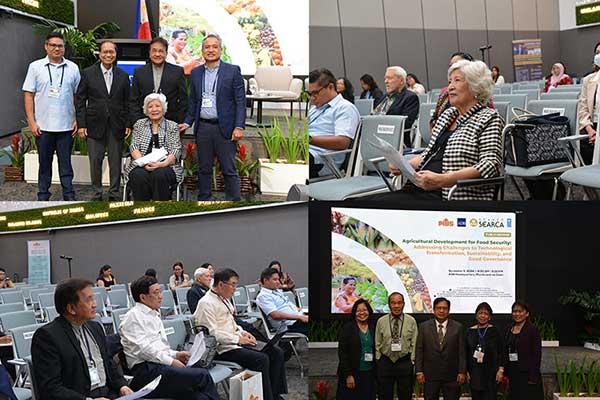
The recent conference hosted by the Philippine Institute for Development Studies (PIDS), in partnership with the Asian Development Bank (ADB), the Southeast Asian Regional Centre for Graduate Study and Research in Agriculture (SEARCA), and the United Nations Development Programme (UNDP), underscored the critical role of community engagement and inter-sectoral collaboration in achieving food security and sustainable agricultural development.
Held under the theme, “Agricultural Development for Food Security: Addressing Challenges to Technological Transformation, Sustainability, and Good Governance”, the conference gathered experts to explore strategies that can address pressing challenges in agriculture. The event featured two parallel afternoon sessions, each focusing on financial access for farmers and agricultural development practices.
In the first session, discussions centered on fiscal policies and schemes that drive competitive growth and food security.
Dr. Mario Lamberto, of the U.P. Public Administration Research and Extension Services Foundation, Incorporated, started the discussion by emphasizing the need for improved access to formal credit for farmers. He stressed the importance of lending institutions like Land Bank to better serve rural areas. “Land Bank should adapt to electronic banking, and it should be the leader in the countryside…They can go anywhere, and farmers can contact Land Bank easily,” Lamberto suggested. He further advocated prioritizing agricultural credit over commercial loans to better support the needs of farmers.
Building on this, PIDS Senior Research Fellow Dr. Roehlano Briones, presented their observations on policy changes in agriculture since the 1960s. He noted positive developments, including increased subsidies, sustained provision of public goods like infrastructure and research, and tariff reductions that allow local production to remain competitive. However, Briones called for stronger coalitions among farmers, consumers, and environmental groups to push for further tariff reforms and resist the restoration of detrimental non-tariff barriers. “If we want to reduce these tariffs further, have a more even tariff reform program, and hold firm against restoration of these more egregious non-tariff barriers, then these coalitions need to form, be strengthened, and be sustained,” he stressed.
Further emphasizing the importance of local engagement, Dr. Cielito Habito, Chairman and Founding Partner of BrainTrust Inc., suggested a strategy of “provincializing” agricultural development. Habito highlighted the agricultural sector’s significant contribution to the national GDP, and advocated for empowering local governments to more effectively support agricultural workers. “Instead of leaving municipal agricultural workers to fend for themselves, we must deliberately capacitate local governments to do their job for them,” he highlighted.
The second parallel session shifted focus to the practical aspects of agricultural production, particularly the role of irrigation and governance in sustaining agricultural productivity.
Dr. Arlene Inocencio, Professor at the School of Economics in De La Salle University Manila discussed the significant impact of climate change on agriculture, alongside the rising costs of food, fertilizer, and fuel. “Perhaps the goal, if there is only one thing we can focus on, is to increase water productivity and its sustainability. Ideally, this goes with climate change resilient infrastructure,” Inocencio stressed while emphasizing protection measures for watersheds to mitigate these challenges. She also recommended equalized allocations for irrigation that enable the production of other high-value crops alongside rice, allowing wider coverage for food security.
On governance, Dr. Fermin Adriano, Advisory Council Member of the Asian Development Bank Institute, recommended looking into policies that foster long-term agricultural sustainability. “We need to provide public goods instead of production inputs, which will only last you the cropping season, and will only benefit individual farmers, compared to public goods that will benefit the community, and will be useful for a longer period of time,” he said. He also advocated for private sector investment in agricultural research, technology transfers, and the establishment of an agency to coordinate extension services with provincial governments, ensuring that regional agricultural needs are met.
Dr. Liborio Cabanilla, Professor at the College of Economic and Management in UP Los Baños, echoed recommendations for a specific and regionalized approach to agricultural development. “The philosophy of the community-driven development is to involve the communities in local development decisions because it’s the right of the citizens,” he said. This approach, he said, yields higher productivity as farmers take ownership of the development of crop varieties, and higher engagement in environmental and community protection.
Overall, the discussions of the parallel sessions highlighted the importance of inclusive policies that encourage participation not only from the agricultural sector, but from communities and adjacent sectors. All discussions paid tribute to former PIDS Senior Research Fellow Dr. Cristina David, whose extensive body of work in agriculture and resource management nurtured the studies presented.
Experts called for better alignment of budgets and greater access to financial and social services for farmers. (PIDS)
Comments (0)
LEAVE A REPLY
No comments yet
Be the first to share your thoughts!
Related Articles

BSP sees August inflation at 5.5%–6.5%
The Bangko Sentral ng Pilipinas expects inflation to settle between 5.5% and 6.5% in August 2026 as weather-related food supply disruptions and elevated domestic fuel costs continue to pressure consumer prices. The forecast means inflation could remain well above the government’s 2%–4% target range, prolonging the squeeze on household purchasing

Philippines’ first MPI finds 12.4% of households poor
About one in eight Filipino households faces overlapping deprivation in education, housing, health, employment, and other basic needs, according to the Philippines’ first official Multidimensional Poverty Index, or MPI. The Philippine Statistics Authority’s new measure found that about 12% of households were multidimensionally poor in 2024, meaning they simultaneously experienced

We love local food. But do we support the people who produce it?
Ilonggos love food. We take pride in our batchoy, pancit molo, native delicacies, seafood, cacao, coffee and the dishes that have made Iloilo a destination in its own right. Since becoming a UNESCO Creative City of Gastronomy, we have had even more reason to celebrate what comes out of our kitchens.