
Domestic claims of OFCs rise by 7.3 percent in Q1 2022
Based on preliminary data on the Other Financial Corporations Survey (OFCS), the domestic claims of the OFCs expanded by 7.3 percent in Q1 2022 to ₱7,330.2 billion from ₱6,832.1 billion in Q1 2021 (Figure 1).[1]
This growth was brought about by higher claims on the private sector and net claims on the central government.[2]
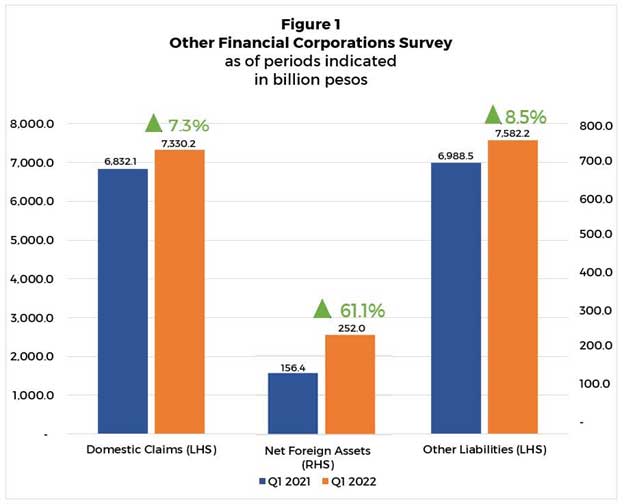
In Q1 2022, the OFCs’ claims on the private sector rose from a year ago, owing to the sector’s higher investments in equity securities issued by private nonfinancial corporations as well as more loans extended to households.
The growth in domestic claims can also be attributed to OFCs’ higher claims on the national government as evidenced by the sector’s increased holdings of government securities.
On the other hand, the OFCs’ claims on depository corporations declined in Q1 2022 compared to the same period last year, mainly due to the sector’s lower bank deposits and decreased holdings of debt securities issued by banks.
Meanwhile, OFCs recorded higher net foreign assets in Q1 2022, largely on account of increased investments in debt and equity securities issued by nonresident entities.
The expansion in the OFCs’ assets was funded primarily by their issuances of shares and other equity.
[1] The OFCS is a comprehensive measure of the claims and liabilities of the OFCs. OFCs refer to institutional units providing financial services other than banks, non-banks with quasi-banking functions, nonstock savings and loan associations, and the central bank. These institutional units are comprised of non-money market funds of trust institutions, trust corporations, and investment companies, private and public insurance corporations, holding companies, government-owned or -controlled corporations engaged in financial intermediation, and other financial intermediaries and auxiliaries.
[2] The private sector is composed of other nonfinancial corporations, and households and non-profit institutions serving households. The other nonfinancial corporations refer to private corporations and quasi-corporations whose principal activity is the production of market goods or nonfinancial services.
Comments (0)
LEAVE A REPLY
No comments yet
Be the first to share your thoughts!
Related Articles

Iloilo City, Shopee team up to boost MSMEs
By Joseph Bernard A. Marzan ILOILO CITY — The city government announced Friday, July 31, a partnership with Shopee Philippines to help micro, small, and medium enterprises expand into online markets. Under the partnership, MSMEs enrolled in the city government’s SIGE Asenso program will gain access to quarterly coaching from Shopee Philippines’ Tatak Pinoy coaches

Bank lending, liquidity growth slow in June
MANILA — Philippine bank lending and domestic liquidity continued to expand in June, although both grew more slowly as businesses borrowed cautiously, household demand remained subdued, and overall credit activity lost momentum. Loans extended by universal and commercial banks grew 9.8 percent from a year earlier, down from 12.1 percent

Philippine business confidence rebounds to neutral in June
By Francis Allan L. Angelo MANILA — Philippine business confidence returned to neutral territory in June as companies expected stronger consumer spending at the start of the academic year and lower oil and energy costs, according to the Bangko Sentral ng Pilipinas. The overall business confidence index rose to 0.0 percent from minus 25.2 percent