DOE staggers fuel hikes amid energy cost surge
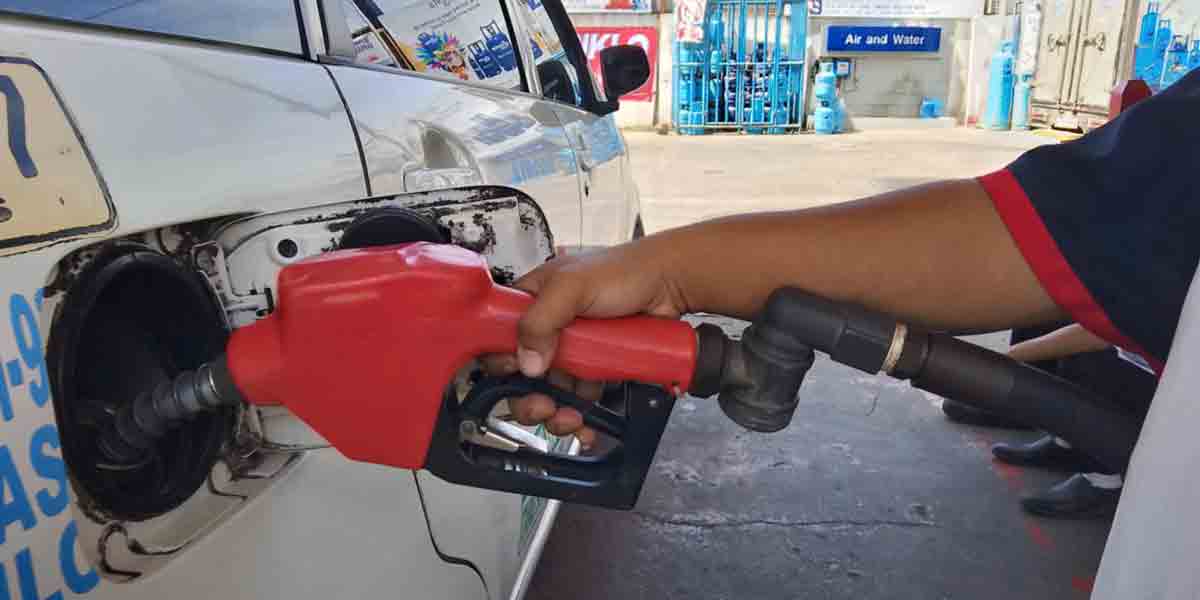
The Department of Energy said oil companies will spread this week’s sharp fuel price increases over several days, as the government also weighs broader emergency measures to contain the impact of rising global energy costs on consumers. The move comes after the DOE announced another major round of fuel price hikes, the second straight week
By Staff Writer
The Department of Energy said oil companies will spread this week’s sharp fuel price increases over several days, as the government also weighs broader emergency measures to contain the impact of rising global energy costs on consumers.
The move comes after the DOE announced another major round of fuel price hikes, the second straight week of steep increases linked to the ongoing Middle East conflict and tensions involving Iran, the United States and Israel.
For the period of March 17 to 23, the DOE projected diesel prices would rise by PHP 20.40 to PHP 23.90 per liter, gasoline prices by PHP 12.90 to PHP 16.60 per liter, and kerosene prices by PHP 6.90 to PHP 8.90 per liter.
The DOE urged oil companies to stagger the increases to soften the immediate burden on motorists, public transport operators and businesses already grappling with elevated fuel costs.
Energy Secretary Sharon Garin said several major fuel retailers had agreed to implement the increases in phases rather than in a single-day adjustment.
Oil firms have agreed to divide the big-time fuel price hikes set this week into smaller hikes spread over several days, the Department of Energy said on Monday.
Garin said Petron, Shell and Flying V agreed to stagger the increases over three days from March 17 to 19, while Seaoil and Total would implement the price hikes over two days from March 17 to 18.
“All these five companies have committed to the staggering and the office of Dir. Rino [Abad] is still working on the other companies kasi we’re waiting for their submissions today,” Garin said in a briefing with journalists.
Following the DOE advisory, oil companies released their own adjustment schedules and rates for the week.
Total said diesel prices would increase by PHP 20.70 per liter, while gasoline prices would rise by PHP 14.10 per liter.
Shell Pilipinas Corp. and Seaoil Philippines Corp. said they would raise gasoline prices by PHP 16.20 per liter and kerosene prices by PHP 6.90 per liter.
Shell said diesel prices would increase by PHP 23.90 per liter, while Seaoil said diesel would go up by PHP 23.30 per liter.
Total and Seaoil said their new prices would take effect until March 18.
Shell, Petron and Flying V said their staggered adjustments would run until March 19.
The latest increases underscore how quickly geopolitical tensions can feed into domestic pump prices in the Philippines, which imports most of its fuel requirements and remains exposed to disruptions in global supply routes.
The government is also exploring measures to blunt the wider economic fallout from higher energy costs, including the possible temporary reduction or suspension of excise taxes on oil products.
President Ferdinand Marcos Jr. is set to request emergency powers from Congress to address the issue, according to the information provided in the release.
The DOE’s response is not limited to transport fuels, as officials are also preparing to intervene in the electricity market amid a separate spike in liquefied natural gas costs.
Philippines moves to cap power prices as LNG costs spike.
Garin told Reuters on Friday that the government was preparing to step into the electricity market to curb rising power bills, warning that surging LNG prices could push tariffs higher.
Shipping disruptions in the Gulf and the Strait of Hormuz, along with a temporary production halt in Qatar, have driven LNG prices to their highest levels since 2022.
Qatar accounts for about one-fifth of global LNG supply, making any disruption there significant for fuel-importing countries in Asia, including the Philippines.
Garin said that without intervention, Philippine power prices could rise by as much as 16% as early as next month.
“The basic idea is to ramp down liquefied natural gas and ramp up coal and renewables,” Garin said, noting that coal-fired plants can quickly replace LNG in supplying the grid.
To cushion consumers from higher electricity charges, the government is seeking emergency powers to regulate power prices, a step Garin said could be implemented as soon as next week.
“Because the cost of living will increase, we are trying to do some temporary relief,” Garin added.
Garin earlier said options such as removing the fuel excise tax would provide only limited and short-term relief compared with the scale of the energy shock.
She said the government could forgo about PHP 300 billion in revenue if the fuel levy were cut.
The DOE said the planned interventions are part of a broader effort to stabilize the grid as the country faces a more volatile imported energy bill.
The department is accelerating renewable energy connections and rescheduling plant maintenance to optimize available supply.
At the same time, the government plans to ramp up coal-fired generation to offset reliance on LNG, reversing last year’s first decline in coal output in nearly two decades.
The strategy highlights Asia’s vulnerability to LNG price swings and the Philippines’ particular exposure to international energy market shocks.
The Philippines is one of the few markets in Asia where power prices are largely unregulated.
Electricity tariffs in the archipelago, home to more than 100 million people, are already the second-highest in the region after Singapore.
“With the exaggerated increase in fuel transportation costs, there’s a multiplier effect,” Garin said.
Some market rules may be temporarily suspended to carry out the relief measures, with distribution utilities offering to increase coal-fired generation in place of LNG.
“We’ll intervene in the market, or whatever is allowed by law, especially for Meralco, which is the biggest distribution utility we have,” Garin said.
Meralco said it supports the DOE’s measures, has enough contracted coal supply, and is coordinating with power suppliers to help limit generation charges.
The government is also in talks with First Gas Power to redirect any unused domestic gas to LNG-fired plants.
Article Information
Comments (0)
LEAVE A REPLY
No comments yet
Be the first to share your thoughts!