
Climate change ‘upsets’ planting calendar – DA-6
By Joseph Bernard A. Marzan
By Joseph Bernard A. Marzan
Shifts in the country’s climate is pushing the Department of Agriculture (DA) to change planting calendars, among other significant farming activities, even as they worry about the necessity of such changes.
In the 2nd quarter “Sugilanunay” press conference, DA-Western Visayas officer-in-charge Jose Albert Barrogo acknowledged that climate change has affected the region’s agricultural sector.
He cited one of the 4 “planks” of Pres. Ferdinand Marcos Jr. administration’s Masagana Rice Industry Development Program (MRIDP) under the DA, which is increasing the resilience of the rice industry through climate change adaptation.
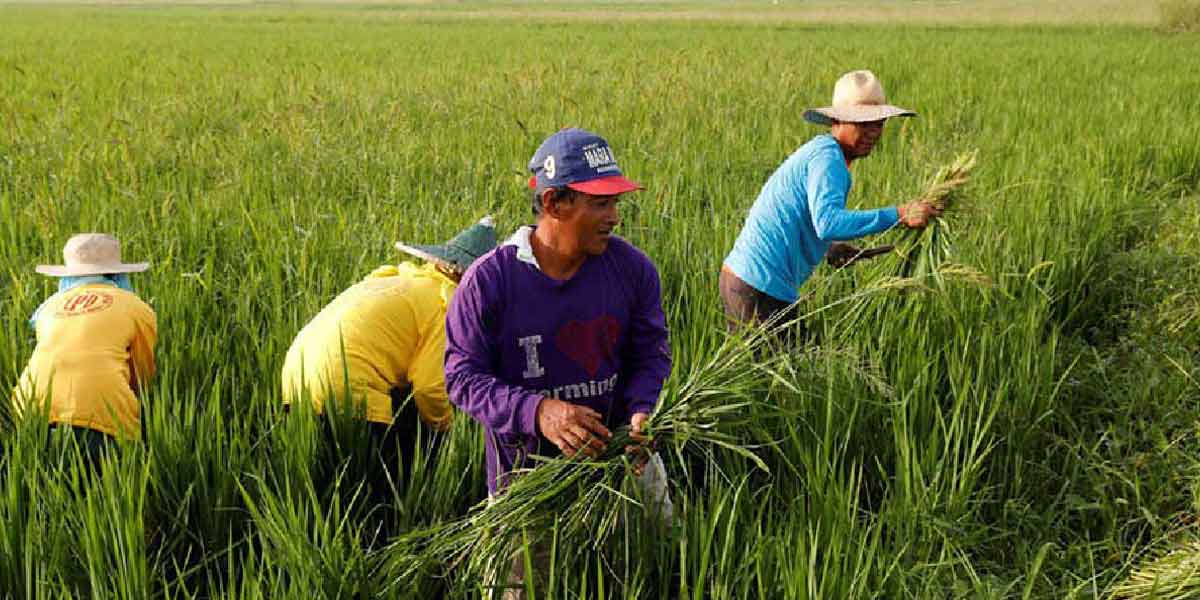
Because of this, he said that they are now looking at changing the rice planting calendar, which is from September to November, to December to January, to avoid the rainy season which also affects crop production.
“In relation to climate change, we are trying to implement changing the planting calendar. Usually, our second cropping begins in September [to] November, within those months. We know that that’s the time when there are many typhoons in Region 6. One of the proposals is to move it to [the period of] December to January,” Barrogo said.
But such a change would prompt DA and farmers to look for sources of irrigation, as water supply might not be stable in these months, which would lead to a smaller production area.
For the unusable production area, they may resort to crop diversification by focusing on crops that would need less irrigation.
The schedule change may result in failure to achieve the target yield per season, which is an additional 5 to 6 hectares of production area.
“When we change or move the planting calendar, another proposal that we have is the area to which the irrigation will be. If there are 100 hectares, and if we move our planting calendar, it could be that we can only have 50 hectares [for planting] because that would only be the [allowed] irrigated area. That 50 irrigated hectares, all production and commercial inputs will be focused there,” he explained.
As to climate-related assistance, Barrogo said the challenge was the uncertainty of DA-Western Visayas’ assistance to farmers due to climate-related events even as he encouraged them to be insured by the Philippine Crop Insurance Corporation (PCIC).
He said that “the PCIC was part of the DA,” despite the state-run insurer being under the supervision of the Department of Finance by virtue of Executive Order No. 148 issued by then-President Rodrigo Duterte in 2021.
While the PCIC’s name only refers to crops, it also provides non-crop-related assistance, including to hog raisers whose livelihoods have been affected by the African Swine Fever (ASF) in the region.
“We are a department [whose] budget has been approved in the previous year. This means that in terms of the climate, we cannot anticipate anything including the challenges which may arrive, so that’s the reason why the DA-6’s assistance [to farmers] is with the PCIC, which is part of the [DA],” Barrogo explained.
“We’ll try our best, hopefully with the help also of our [local government units], that our farmers and hog raisers wouldn’t take for granted the assistance given by the [DA]. The [DA] in times of calamity, in times of diseases, in times of drought, has financial assistance through the PCIC,” he added.
DA-6 in May projected losing production of between 69,354.72 to 429,575.68 metric tons of rice and 5,604.65 to 27,066.18 metric tons of corn during the upcoming El Niño season, which is expected to run from September this year to March next year.
CONTRIBUTING FACTORS
DA-6 Regional Technical Director for Research and Regulation Zarlina Cuello said changes to the planting calendar are not solely based on their discretion, but on contributing factors that make it difficult for farmers to plant in the current cycle.
One factor Cuello mentioned was the increasing speed of industrialization, particularly in the development of manufacturing and consumer facilities which leave lesser space for agricultural activities.
“We have a lot of food because we have more malls, factories, and other industries in our landscapes. That is one of the contributing factors to climate change, and that makes it difficult for us to plant right in the traditional cropping calendar,” she added.
She said that the Marcos Jr. administration is pursuing many programs under the DA-6 to fulfill a ‘whole-of-government’ approach from the national to the local governments, to ensure food security amid the uncertain climate.
At the end of the DA-6, Cuello said that they are currently researching on nutrient-balanced fertilization, due to the negative effects of rising temperatures on the soil, as well as the use of technologies on seed distribution and detection of lacking soil nutrients.
Comments (0)
LEAVE A REPLY
No comments yet
Be the first to share your thoughts!


