
Classroom Shortage Worsens as Kanlaon Evacuees Stay
By Glazyl M. Jopson
BACOLOD CITY – With the new school year approaching, the continued use of public schools as evacuation centers for Kanlaon Volcano evacuees is raising concerns in Negros Occidental, especially in La Castellana town.
According to the Office of Civil Defense–Negros Island Region, or OCD-NIR, about 2,448 families remain in evacuation centers as of this week—more than a year since Kanlaon erupted on June 3, 2024.
Department of Education–Negros Occidental spokesperson Ian Arnold Arnaez said Tuesday that schools are only legally allowed to serve as evacuation centers for up to 15 days.
After that, local government units are expected to provide concrete relocation plans.
However, Arnaez admitted that enforcing this policy remains difficult.
“The municipal government of La Castellana has proposed three relocation options,” he said. “But we’re closely monitoring developments to adjust our class schedules accordingly.”
With classes set to begin on June 16, and in the absence of finalized relocation plans, temporary classrooms and learning spaces within evacuation centers will again be used this school year.
“For humanitarian reasons, we cannot simply evict evacuees with nowhere to go,” Arnaez said.
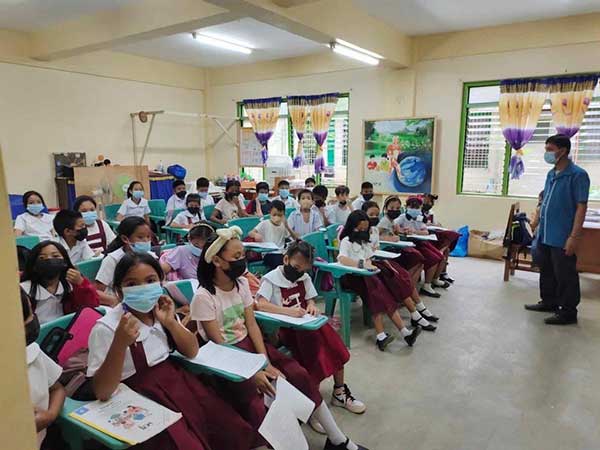
But prolonged use of schools as shelters disrupts education and limits access to proper learning environments.
An estimated 8,923 students will be affected in La Castellana, where three schools are being used as evacuation centers: La Castellana Elementary School with 1,495 students, Don Felix Robles Elementary School with 1,768 students, and La Castellana National High School with 5,660 students.
Additional affected schools include Cabagna-an Elementary School with 296 students, Mananawin Elementary School with 145, Old Fabrica Elementary School with 286, Sag-ang Integrated School with 757, and Biak na Bato Elementary School with 474.
Arnaez noted that there are not enough classrooms for displaced students, and the few that remain in affected schools cannot accommodate everyone.
To cope, these schools have implemented shifting class schedules and adopted distance learning models, limiting face-to-face sessions to once a week.
Arnaez stressed that this setup is not conducive to quality education.
Some relief has come from partners and the OCD, which have provided temporary learning spaces made of canopy tents.
But Arnaez said these are inadequate substitutes for real classrooms and offer little protection from heat, dust, and wind.
Last year, each canopy-type space could only accommodate 14 students per session.
Until a long-term relocation solution is found, schools will continue operating under constrained and improvised conditions.
“In the end, we have no choice. We have to embrace reality and adapt to it,” Arnaez said. “It’s not ideal, but we must fulfill our mandate.”
OCD-NIR Regional Director Donato Sermeno III acknowledged the pressure on La Castellana’s local government, which has requested 30 additional family tents to help decongest schools.
He said the agency is also exploring the use of bamboo and other native materials to construct temporary classrooms.
The number of families in evacuation centers has dropped slightly to around 2,400, as some residents living outside the six-kilometer Extended Danger Zone have returned home.
Sermeno explained that many initially sought shelter due to fear, following months of intensified volcanic activity.
At Alert Level 3 last month, OCD recorded about 2,600 displaced families—or roughly 8,300 individuals.
Currently, 23 evacuation centers remain operational: 10 in Canlaon City in Negros Oriental, eight in La Castellana, and five in La Carlota City, both in Negros Occidental.
Sermeno acknowledged the psychological and logistical strain on internally displaced persons, many of whom have been living in schools for over a year.
On June 2—one day before the eruption’s first anniversary—the Philippine Institute of Volcanology and Seismology recorded a 29-minute ash emission, 38 volcanic earthquakes, and 1,460 tons of sulfur dioxide from Kanlaon.
Thin ashfall was reported in Barangays Ilijan, Binubuhan, and Mailum in Bago City.
Sermeno warned that the threat of another eruption remains high.
“The number of volcanic earthquakes is quite alarming. The danger is still there,” he said.
Kanlaon also erupted on Dec. 9, 2024, and again earlier this year.
The OCD-NIR is currently reviewing proposed sites for permanent evacuation centers and resettlement areas in four LGUs: La Castellana, La Carlota City, Bago City, and San Carlos City—all in Negros Occidental.
Comments (0)
LEAVE A REPLY
No comments yet
Be the first to share your thoughts!


