
BRIDGING GAPS: ATIPAN Telehealth Expands Indigenous Health Access
By Mariela Angella Oladive
For many Ati communities in Western Visayas, accessing healthcare has long been a challenge due to financial constraints, transportation barriers, and limited medical facilities.
Through the ATIPAN project—a pioneering digital health initiative—these hurdles are gradually being overcome, bringing much-needed medical services closer to marginalized populations.
ATIPAN, which means “to take care of” in Hiligaynon, offers telehealth consultations, essential medication, and training for community health workers in 15 underserved Indigenous and rural low-income communities in the region.
The program is supported by international organizations such as the International Development Research Centre (IDRC) of Canada and the United Kingdom’s Foreign, Commonwealth & Development Office (FCDO).
It has played a critical role in ensuring access to healthcare through digital innovation.
Leonisa Lumangyao, an Ati health coordinator, shared how ATIPAN eased her community’s struggles, especially during the COVID-19 pandemic when access to medical services was even more limited.
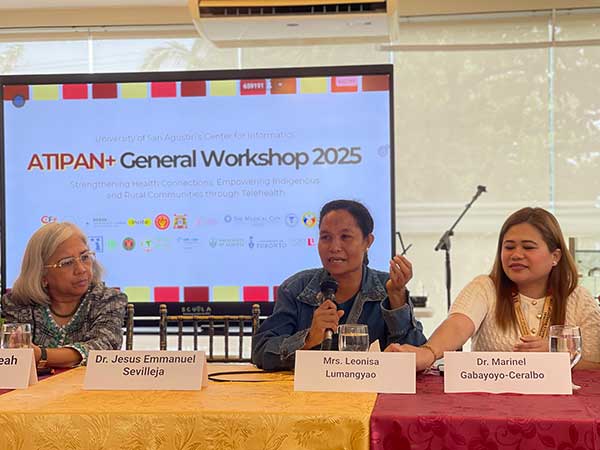
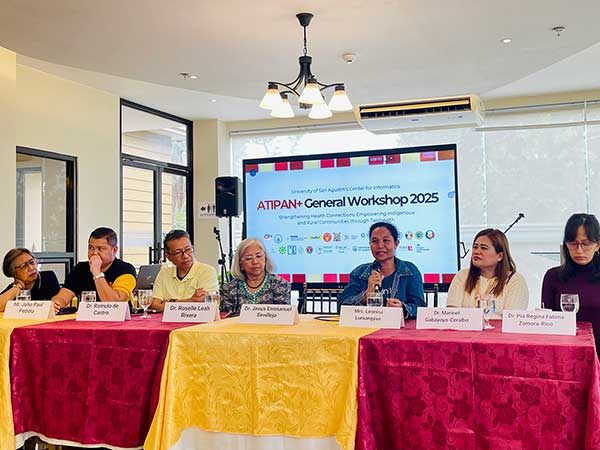
“For us Ati, we initially rely on our traditional herbal medicines,” Lumangyao said at a press conference during the ATIPAN+ General Workshop on March 20.
“We have a first-aid practice called hampul-hampulan, but if it proves ineffective or the condition doesn’t improve after a few days, we turn to medicine provided by doctors. The problem is that we often cannot afford medicines or transportation to health centers.”
She recalled how life during the pandemic was especially difficult, with the high cost of transportation forcing them to choose between spending on fare or medicine.
She emphasized that the program had been a great help in addressing their basic health needs.
“As a health coordinator under this program, I also feel empowered,” she added.
“I am no longer confined to my own community. This initiative has extended beyond us Ati, and it shows that we, as mga Ati, are capable of engaging with and being recognized by utas (non-Ati people).”
With telehealth services, patients in remote areas can now consult doctors without the burden of long and costly travel.
Community health coordinators—comprising tribal elders, community leaders, and Indigenous and rural low-income youth—facilitate the consultations.
Strengthening Local Healthcare Systems
Prof. John Paul Petrola, an expert on Indigenous communities, emphasized the importance of local government support in sustaining the program’s impact.
“If local governments and partners can provide more medicines, ambulances, and even telehealth satellite hubs, we can enhance accessibility,” Petrola said.
He also highlighted the need to strengthen partnerships with Barangay Health Workers (BHWs) to help secure patient records and improve access to financial assistance.
The success of ATIPAN has not only provided immediate medical relief but also demonstrated the potential of digital health in addressing systemic inequities.
Dr. Romulo de Castro, ATIPAN project lead and Balik Scientist, stressed the need to align health policies with ground-level realities to achieve universal health care (UHC).
“We now have data from communities that were never included in our public health records before,” he said.
“The challenge is how we use this information to push for policies that remove barriers to healthcare access.”
He noted that following discussions with the National Economic and Development Authority (NEDA), the goal is to integrate ATIPAN’s findings into national healthcare policy.
“If we really want to go for equity, we need to go to the communities most affected by disparities and innovate there,” he added.
“When we innovate with them, they will show us the way.”
Themed “Strengthening Health Connections: Empowering Indigenous and Rural Communities through Telehealth,” the ATIPAN+ General Workshop, held until March 22, focused on scaling up telehealth services and enhancing long-term support for marginalized communities.
Comments (0)
LEAVE A REPLY
No comments yet
Be the first to share your thoughts!
Related Articles

UNDECLARED MILLIONS: Alleged hidden wealth of Duterte couple hits PHP 817 million, prosecution witness says
The combined alleged undeclared assets and unexplained wealth of Vice President Sara Duterte and her husband, lawyer Manases “Mans” Carpio, have reached nearly PHP 1 billion, according to an analysis by veteran financial expert Alexander “Alex” B. Cabrera that prosecutors presented Friday before the Senate impeachment court. A table based

Flood control tops PHP 16.9B infra plan for Western Visayas
ILOILO CITY — The Department of Public Works and Highways (DPWH) has proposed PHP 16.9 billion in infrastructure projects for Western Visayas in 2027, with flood control getting the biggest share at PHP 6.07 billion. Local infrastructure projects under a program alleged to be a vehicle for congressional pork barrel received

Iloilo saves PHP 2 million through solar installations
ILOILO CITY — The Iloilo provincial government saved more than PHP 2.015 million in electricity costs from January to May 2026 through solar photovoltaic installations at the Provincial Capitol Complex and five government hospitals. Data from the 4K for MoRProGRes Dashboard showed that the solar facilities generated a combined 180,803 kilowatt-hours