
Billboards in Iloilo City Limited to Ads, Not Politics
By Rjay Zuriaga Castor
By Rjay Zuriaga Castor
The Office of the Building Official (OBO) clarified that billboards, streamers, and posters on private or commercial properties are allowed only for advertisements directly related to the products or tenants within the building.
OBO head Engr. Mavi Gustilo said billboards promoting unrelated content, such as political campaigns, are prohibited, especially if they lack the required permits.
“It is allowed provided that what is being advertised is their own product or something inside that building. This is what we call onsite advertisements,” Gustilo said in an interview.
She cited examples, such as the Emicon building, where advertisements for unrelated products, like Ashton Homes, would be permissible only if properly permitted.
Gustilo emphasized that even for legitimate advertisements, building owners must secure permits, including a building permit, certificate to use, and a signed permit from the OBO.
The clarification came amid concerns over why billboards in malls such as SM City Iloilo and Robinsons Place were not removed.
In the case of the Emicon building on Donato Pison Avenue, San Rafael, Mandurriao, Gustilo confirmed violations of both the city’s local ordinance and the National Building Code of the Philippines (NBCP) or Presidential Decree No. 1096.
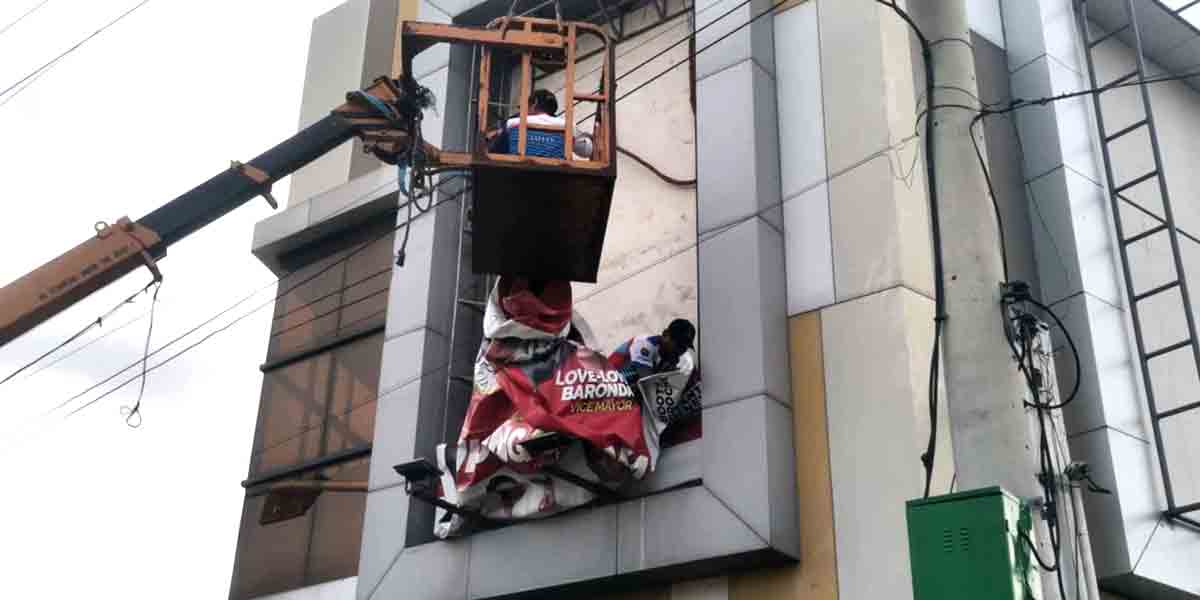
The building had installed a billboard promoting the Sulong-Gugma slate of Iloilo City Lone District Representative Julienne “Jamjam” Baronda.
Operatives from the Task Force on Anti-Squatting and Illegal Structures and the OBO removed the billboard on Monday, December 16.
Gustilo said the building violated the city’s Regulation Ordinance No. 2013-330, passed during the administration of former Mayor Jed Patrick Mabilog and amended in 2020.
The ordinance prohibits installing streamers, billboards, posters, and advertisements in public plazas, parks, and other specific locations, including on rooftops and alongside buildings.
It also bans the selling, leasing, or use of properties to construct billboards along the 6-kilometer stretch of Sen. Benigno S. Aquino Avenue.
The 2020 amendment generalized the prohibition, banning billboards and streamers in any part of Iloilo City and expanding removal efforts to cover all commercial billboards and signs.
Additionally, Gustilo noted that the Emicon building violated the NBCP because it lacked a signed permit from the OBO.
“They also violated the NBCP, which requires that for ground-mounted and roof-mounted billboards, they must obtain a building permit, a certificate to use, and a signed permit,” she stressed.
The signed permit ensures compliance with structural integrity, safety protocols, and aesthetic considerations.
To date, the OBO has removed unauthorized billboards at Vishari Building on E. Lopez Street in Jaro; Mandurriao Market; Alfonso Tan Building at Iznart and Solis Streets, City Proper; and Stronghold Building on Donato Pison Avenue, Mandurriao, which had displayed a billboard for senatorial candidate Rodante Marcoleta.
Comments (0)
LEAVE A REPLY
No comments yet
Be the first to share your thoughts!


