
70% of social sector organizations are insufficiently prepared against cybersecurity threats
The Centre for Asian Philanthropy and Society (CAPS), a uniquely Asia, independent, action-oriented research and advisory organization, today released the 2024 edition of its flagship study, the Doing Good Index.
The study finds that despite the rapid digitalization of the Asian social sector, social delivery organizations (SDOs)[1] are struggling to keep up with technological changes due to inadequate access to digital infrastructure, lack of capacity, and insufficient donor support.
As technology continues to advance, a new type of digital divide is being created that hampers the ability of the social sector to deliver products and services to the most vulnerable communities.
The Index finds that digital technology has become commonplace in the social sector in Asia. 95% of the organizations surveyed use digital technology to carry out their work, with 88% intending to increase their use of digital technology in the next two years.
However, SDOs in Asia lack the necessary resources to fully leverage the benefits of digital technology and protect themselves against the associated risks. 59% of surveyed SDOs said their staff lack the skills to use digital tools effectively, and 70% do not have, or are unaware of, an organizational cybersecurity strategy.
When asked about their organization’s top technology needs, hardware, operational software and staff training emerged as the top three.
According to the Index, access to operational funding is essential for organizations to respond adequately to the rapidly changing digital landscape. Almost half of SDOs report that their donors do not fund digital technology and IT costs, indicating a glaring funding gap.
“Asia’s social sector is unprepared for technological change amidst the rapid digitalization in the region. We believe philanthropy can play a crucial role in meeting digital technology needs. Donors should recognize that challenges in securing operational funding hinder the organizations they support from investing in digital technology that could improve their productivity and impact. Operational funding and in-kind donations can help social delivery organizations invest in capacity building to fully leverage digital technologies to meet their mission of helping our communities.” said Dr. Ruth Shapiro, the Co-Founder and Chief Executive of CAPS.
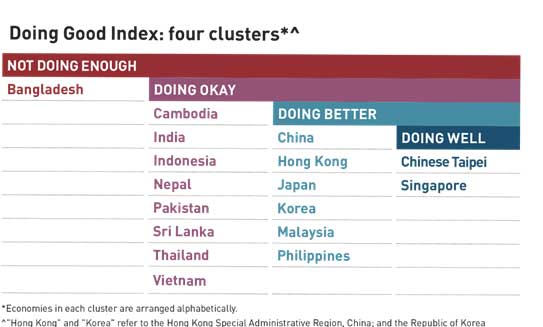
In addition to technological challenges, the Doing Good Index also shares how economies across the region are or are not creating enabling environments for the giving and receiving of private social investment such as philanthropy and corporate social responsibility (CSR).
Against the backdrop of the tumultuous Covid-19 years, there has been little change across the four sub-indexes[2] of the Doing Good Index in the last two years. Aside from Sri Lanka, which improved in performance, all other economies have remained in the same clusters as 2022.
Funding to the social sector has remained mostly unchanged. Domestic funding (from individuals, foundations and companies) remains the main funding source for SDOs across Asia, comprising 64% by proportion of the average SDO’s budget. Government funding (20%) and foreign funding (15%) as a proportion of an SDO’s budget have also remained steady.
Funding shortfalls, staffing challenges, and staff upskilling/reskilling are the top challenges facing the social sector. Almost three-quarters (73%) of SDOs struggle to recruit staff, and 69% report difficulty retaining them.
Governments continue to send mixed messages on social sector regulations. While some governments embrace the social sector as a partner, others are showing a hot-and-cold approach, at times encouraging its growth and at others implementing overly burdensome regulations and restrictions.
The role of SDOs remains important, and they generally feel supported. There is also strong optimism within the sector, even after the turmoil of the last few years. This demonstrates the resilience of SDOs in the face of unprecedented challenges.
Mr. Ronnie Chan, the Co-Founder and Chair of CAPS, said, “With ongoing crises ranging from regional conflicts to climate change, Asia faces an uphill battle to create a more equitable future. The good news is that with increasing private wealth, Asia has a unique opportunity to leap ahead and implement policies and programs to solve community problems. We at CAPS are pleased to release the fourth iteration of the Doing Good Index, offering actionable and evidence-based insights for business leaders, philanthropists, and policymakers to consider how they can facilitate and increase private capital flows toward the social sector. The Doing Good Index also offers a blueprint for a more equitable, sustainable, and prosperous future for the region.”
[1] Social delivery organization (SDO) refers to entities engaged in providing a product or service that addresses a societal need.
[2] Regulations, Tax and Fiscal Policy, Ecosystem and Procurement.
[3] Bangladesh, Cambodia, China, Hong Kong, India, Indonesia, Japan, Korea, Malaysia, Nepal, Pakistan, Philippines, Singapore, Sri Lanka, Chinese Taipei, Thailand, and Vietnam.
Comments (0)
LEAVE A REPLY
No comments yet
Be the first to share your thoughts!
Related Articles

60 ASEAN coffee brewers compete in Iloilo
ILOILO CITY – Sixty specialty coffee brewers from the Philippines, Thailand and Malaysia are competing at SM City Iloilo on Nov. 19-20 for the ASEAN Coffee Brewer League 2026. The Department of Trade and Industry Region 6 is co-hosting the two-day competition alongside Panubli-on, Western Visayas’ regional heritage and trade fair. The event brings coffee

Hotel101 signs deal for 606-room Johor Bahru hotel
Hotel101 Global Holdings Corp. said on Nov. 20, 2026, that it signed binding agreements to develop a roughly 606-room hotel in Johor Bahru, Malaysia, that it expects to become the city’s largest by room count. The project puts Philippine-listed DoubleDragon Corp.’s hotel subsidiary near one of the world’s busiest land crossings, where a new rail

DOE backs ACEN’s surrender of 13 renewable energy contracts
The Department of Energy (DOE) welcomed ACEN Corp.’s voluntary surrender of 13 solar and wind contracts covering nearly 5 gigawatts (GW) of proposed capacity in Luzon, saying the move could open the sites to other power producers. The projects were still in early development, so the surrender removes planned capacity rather than electricity already serving